You are here:
Quote-Level Revenue Flow
Review how bookings flow to billings, cash, and revenue over the quote-to-invoice process. (Salesforce Billing Managed Package)
Before we begin, let’s look a table of subscription contracts for context. Let’s say your company sells bronze, silver, and platinum mobile device management plans monthly and annually. Bronze plans are $650 per month, Silver plans are $950 per month, and Platinum plans are $1,400 per month. Contracts are for one year and can be purchased for monthly billing or annual billing. One of your accounts has the following plan contracts.
| Customer | Subscription | Starting Month | Billing Type | Monthly Fee | Contract Total |
|---|---|---|---|---|---|
| A | Platinum | March | Monthly | $1,400 | $16,800 |
| B | Bronze | March | Annually | $650 | $7,800 |
| C | Bronze | April | Annually | $650 | $7,800 |
| D | Platinum | May | Monthly | $1,400 | $16,800 |
| E | Bronze | May | Monthly | $650 | $7,800 |
| F | Silver | June | Annually | $950 | $11,400 |
Bookings
Bookings refers to a prospective contract’s value over a time period. It represents the amount you’re expecting to make from the contract. For example, when Customer A orders their $1400-a-month contract for 12 months, the contract has a $16,800 bookings value. You often see references to bookings in proposals, statements of work, and other presales documents.
At the end of a billing period, such as one month, your bookings for that period represent the total of closed deals in that period in terms of the full contract duration.
| Month | Bookings | What's Included |
|---|---|---|
| March | $24,600 | Contract total for Customer A and Customer B |
| April | $7,800 | Contract total for Customer C |
| May | $24,600 | Contract total for Customer D and Customer E |
| June | $11,400 | Contract total for Customer F |
Companies use bookings to evaluate and plan for future revenue growth. For example, if you notice that your bookings are consistently low in March but high in June, you can evaluate June sales patterns and see if you can apply them during March or other low-bookings months.
Billings
Billings refer to the actual billed amount that a customer receives on their invoice for the invoice for a given billing period. You can think about billings as the cash you get when a service has been invoiced, while bookings is the revenue you expect to get after a service has been delivered. When you calculate Billings for a given period, include all the accounts that are active for that period, not just the new ones — for example, when you calculate billings for March, include both accounts that started in March and any accounts that started in January and February that are still billing.
Let’s look at the original accounts table again, where your customers have annual and monthly subscription plans. When you calculate billings each month, remember that the annual customers pay their total contract cost up-front, while monthly customers pay every month.
| Month | Bookings | Billings | What's Included |
|---|---|---|---|
| March | $24,600 | $9,200 | Customer A’s $1,400 (monthly) and Customer B’s $7,800 (annual) |
| April | $7,800 | $7,800 | Customer C’s $7,800 (annual) |
| May | $24,600 | $2,050 | Customer D’s $1,400 (monthly) and Customer E’s $650 (monthly) |
| June | $11,400 | $11,400 | Customer F’s $11,400 (annual) |
Because bookings aren’t evaluated on financial reports or income statements, billings are the key metric for letting your company accurately track the money it’s owed. Your financial managers report your billings on your company’s balance sheets and income statements.
Revenue
Revenue refers to the income you earn after the customer is invoiced. Revenue is different from billings in this sense, as billings are calculated at the end of the billing period but before service is provided. For example, most businesses charge customers for a contract before providing that billing period’s worth of services. After the service is delivered, the business can recognize the revenue. This flow ensures that businesses follow Generally Accepted Accounting Principles rules, which state that you can recognize revenue only after you’ve “earned” it.
Your revenue generally looks different from your billings because it tracks only the services delivered at the end of the billing period. Even though Customer B paid their entire $7,800 up front, we track only $650 for them in March, given the services they received at the end of March ($7,800 ÷ 12 = $650). Similar to billings, revenue also includes contracts that started in earlier months but are still being invoiced.
A company can recognize revenue only if it meets the ASC 606 standards for recognizing revenue.
| Month | Bookings | Billings | Revenue | What's Included |
|---|---|---|---|---|
| March | $24,600 | $9,200 | $2,050 | Customer A’s $1,400 and Customer B’s $650. |
| April | $7,800 | $7,800 | $650 | Customer C’s $650. |
| May | $24,600 | $2050 | $2,050 | Customer D’s $1,400 and Customer E’s $650. |
| June | $11,400 | $11,400 | $950 | Customer F’s $950. |
If you billed money but haven’t delivered the service (and thus can’t recognize it), you can track it as deferred revenue. You can calculate deferred revenue as Billings−Total Revenue.
| Month | Bookings | Billings | Revenue | Deferred Revenue |
|---|---|---|---|---|
| March | $24,600 | $9,200 | $2,050 | $7,150 |
| April | $7,800 | $7,800 | $650 | $7,150 |
| May | $24,600 | $2,050 | $2,050 | $0 |
| June | $11,400 | $11,400 | $950 | $10,450 |
Cash Flow
After you invoice a customer, the amount owed is considered revenue. Cash flow refers to the net amount of cash moving in and out of a company—in other words, the amount of money that a customer has paid. You can use revenue to track your company’s sales and marketing effectiveness, while cash flow represents your company’s actual liquidity.
Your cash flow likely varies relative to your revenue over a series of billing periods. For example, some customers don’t pay an invoice immediately after receiving it. This condition causes the cash flow for invoices sent out within a given billing period to be lower than revenue accumulated in that specific period. However, if customers pay several invoices from an earlier period at the same time, that influx can cause the current period’s cash flow to be higher than the period’s revenue.
| Month | Bookings | Billings | Revenue | Cash Flow | What's Included |
|---|---|---|---|---|---|
| March | $24,600 | $9,200 | $2,050 | $7,800 | Customer B paid their invoice during this period, but Customer A did not. |
| April | $7,800 | $7,800 | $650 | $10,600 | Customers A, B, C, and D paid their invoices during this period. Customer A also paid their late January invoice. |
| May | $24,600 | $2,050 | $2,050 | $10,600 | All customers paid their invoices during this period. |
| June | $11,400 | $11,400 | $950 | $14,200 | All customers paid their invoices during this period. |
Putting It Together
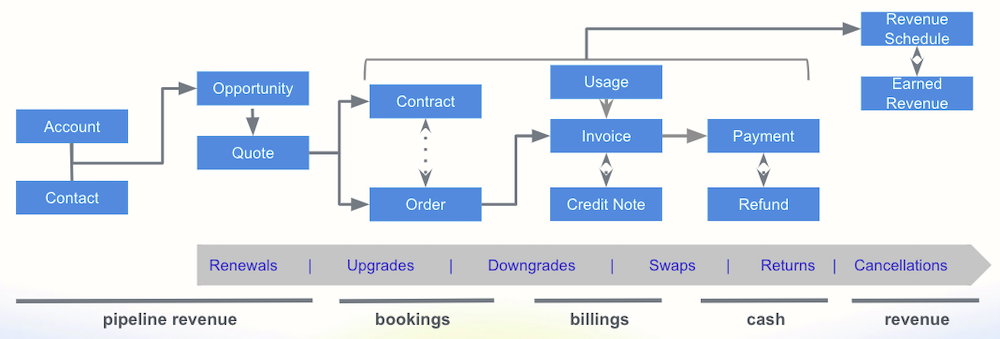
Now that you’ve reviewed the basics, here’s how the bookings-to-revenue pipeline aligns with the Salesforce CPQ and Salesforce Billing workflow.