Email Data Capture Configuration for Sync Email as Salesforce Activity
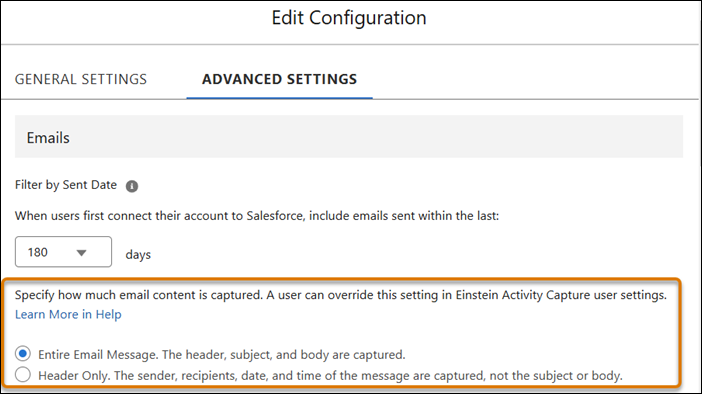
When Sync Email as Salesforce Activity is enabled in Einstein Activity Capture, you can
control the amount of email data captured: entire email message or header only. The header-only
capture option gives you more privacy by letting you capture only the sender, recipients, and
date and time the email was sent.
Required Editions
Available in: Lightning Experience
Available with Einstein Activity Capture Standard in Sales in Starter,
Pro Suite, Professional, and Enterprise Editions
Available with Unlimited Edition, Einstein 1 Sales Edition, and
Agentforce 1 Edition
Available with Einstein for Sales, which is included in Einstein 1 Sales
Edition and available for an extra cost in Enterprise and
Unlimited Editions
Available with Sales Engagement, which is included with Sales in
Performance and Unlimited Editions, and available for an extra cost
in Professional and Enterprise Editions
Available with Revenue Intelligence, which is available for an extra cost in
Enterprise and Unlimited Editions
Note We’re reorganizing the Einstein Activity Capture documentation. We’re
moving some information around, but we aren’t deleting anything.
Choose how you want email to be captured in your personal Email Capture Settings in Einstein
Activity Capture. Your personal settings override the email capture settings configured by
admins in Advanced Settings in Einstein Activity Capture setup. When capture settings are
changed, they apply to future synced emails. (Past synced emails are unchanged).
Note Emails sent from Salesforce Lightning Experience, or manually logged from
Outlook or Gmail, will always have full content captured.
Header-only capture isn’t available for emails sent via the Salesforce Email Composer. The
entire email message will be captured.
Did this article solve your issue?
Let us know so we can improve!
Loading
Salesforce Help | Article
Cookie Consent Manager
General Information
Required Cookies
Functional Cookies
Advertising Cookies
General Information
We use three kinds of cookies on our websites: required, functional, and advertising. You can choose whether functional and advertising cookies apply. Click on the different cookie categories to find out more about each category and to change the default settings.
Privacy Statement
Required Cookies
Always Active
Required cookies are necessary for basic website functionality. Some examples include: session cookies needed to transmit the website, authentication cookies, and security cookies.
Functional Cookies
Functional cookies enhance functions, performance, and services on the website. Some examples include: cookies used to analyze site traffic, cookies used for market research, and cookies used to display advertising that is not directed to a particular individual.
Advertising Cookies
Advertising cookies track activity across websites in order to understand a viewer’s interests, and direct them specific marketing. Some examples include: cookies used for remarketing, or interest-based advertising.