You’re having a productive day reading and responding to email messages, connecting with
your customers, and following up on leads. You see an email from a new prospect and you want
to add the prospect to Salesforce, or you want to capture a new task. Add the records to
Salesforce without leaving your email.
Required Editions
Available in: Salesforce Classic and
Lightning Experience
Available with Sales Cloud, Service Cloud, and Lightning Platform in:
Essentials, Group, Professional, Enterprise,
Performance, Unlimited, and Developer Editions
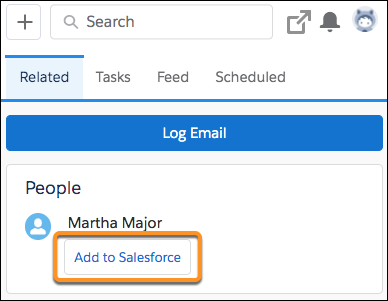
In an open email, the integration recognizes email addresses that don’t match a record in
Salesforce. Add those people to Salesforce as a new contact or lead.
Note The integration shows up to 15 contacts or leads in the side
panel. If there are more than 15 recipients in an email, not all the recipients are available
in the list.
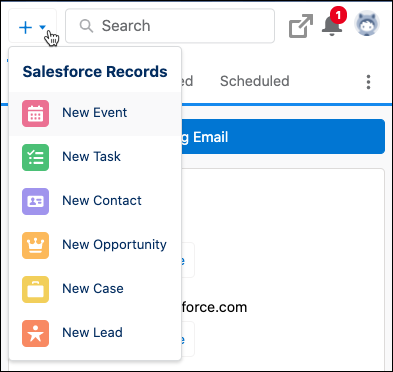
You can also create records at any time using the add option in the navigation bar.
Tip When you create a contact or lead, the first name, last name, and email address
populate with information from the sender’s email address in the open email. If the sender’s
email domain matches a company in Salesforce, the company name is also populated. When you
create a task or case, additional information, such as the subject and description, are
populated with information from the open email.
Did this article solve your issue?
Let us know so we can improve!
Loading
Salesforce Help | Article
Cookie Consent Manager
General Information
Required Cookies
Functional Cookies
Advertising Cookies
General Information
We use three kinds of cookies on our websites: required, functional, and advertising. You can choose whether functional and advertising cookies apply. Click on the different cookie categories to find out more about each category and to change the default settings.
Privacy Statement
Required Cookies
Always Active
Required cookies are necessary for basic website functionality. Some examples include: session cookies needed to transmit the website, authentication cookies, and security cookies.
Functional Cookies
Functional cookies enhance functions, performance, and services on the website. Some examples include: cookies used to analyze site traffic, cookies used for market research, and cookies used to display advertising that is not directed to a particular individual.
Advertising Cookies
Advertising cookies track activity across websites in order to understand a viewer’s interests, and direct them specific marketing. Some examples include: cookies used for remarketing, or interest-based advertising.