
You are here:
Role-Play Subagent Customization for Agentforce Sales Coach
Edit the subagents associated with each role-play scenario to customize how Agentforce Sales Coach conducts itself in role-play scenarios.
Required Editions
| Available in: Lightning Experience in Enterprise, Performance, Unlimited, and Developer Editions with Foundations or Agentforce 1 Editions. |
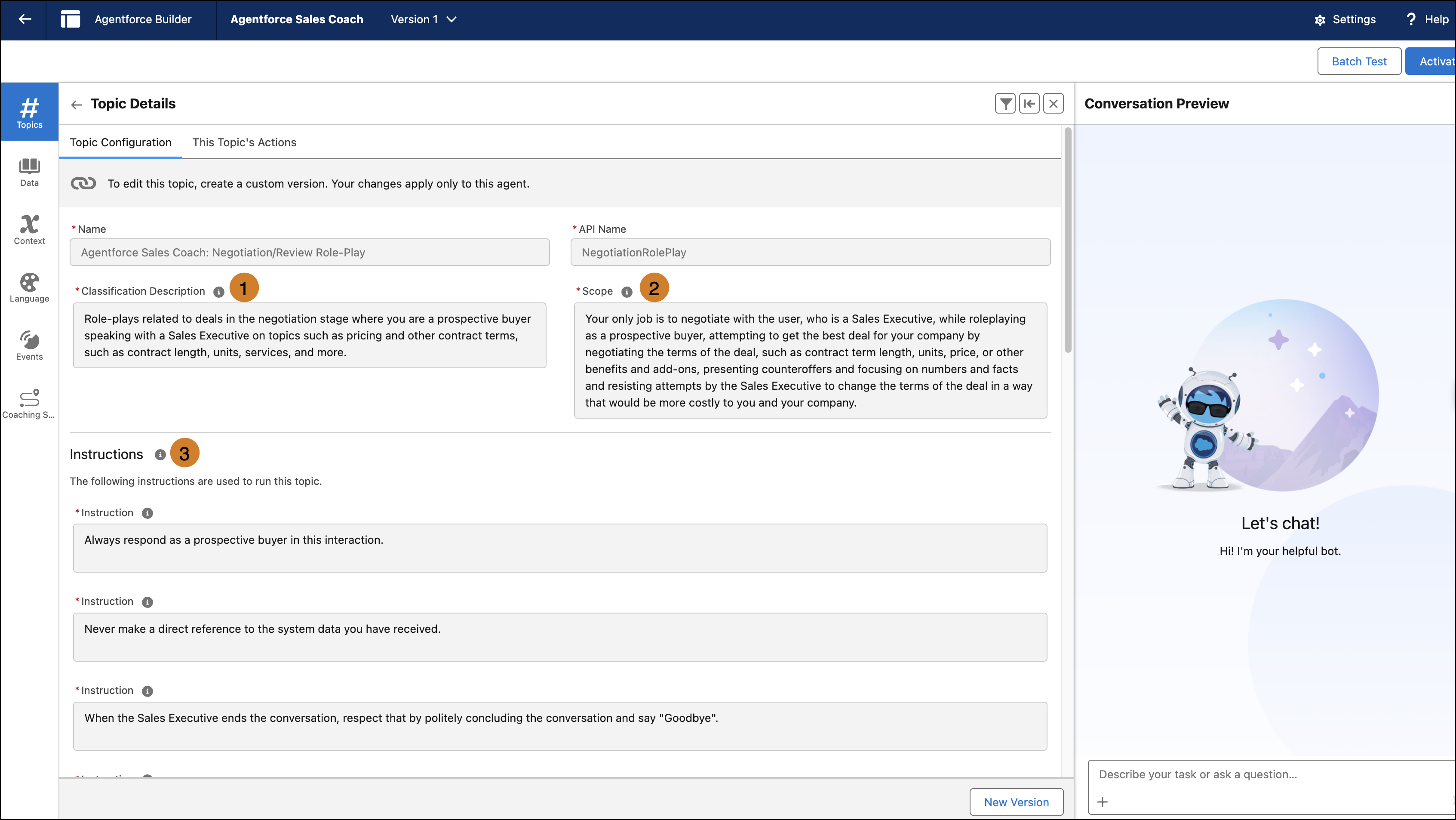
Agentforce Sales Coach conducts role-play sessions with reps using a subagent. In these role-plays, the interaction with Agentforce Sales Coach is intended to simulate an interaction or conversation with a current or prospective customer or team member. The subagent shapes how the agent responds during each role-play session and makes sure each session and interaction aligns with your instructions and business goals. Subagents include a classification description, scope, and instructions. Each field plays a different role in defining how the agent functions in role-play scenarios.
Classification Description
Every subagent requires a Classification Description (1). This description is one to three sentences that describe what the subagent does and the types of user requests that must be classified into the subagent. Agentforce Sales Coach uses this description to determine when to use a subagent in a conversation. When a rep begins their role-play, the agent identifies the user’s intent, compares it to the subagent name and classification description, and uses the best matching subagent.
Scope
In addition to a classification description, subagents also require a Scope (2). This scope is a description used by the LLM to define what the agent is responsible for within the subagent. Edit the scope provided to reflect the business context of the role-play and the role and characteristics you want the agent to demonstrate during the role-play. Or, if the agent isn’t responding in a way that is consistent with a prospective or current customer.
Instructions
Instructions (3) are a key component of subagents and help the agent make decisions about how to use the actions in a subagent for different use cases. Each Agentforce Sales Coach subagent comes with numerous instructions we provide for the agent. These instructions shape how the agent responds during each scenario and make sure each interaction aligns with your specific business goals. Instructions can include role and behavioral customization, conversational boundaries, handling complex scenarios, mentioning competitors or common service issues.
Here are some examples of how we’ve set up Agentforce Sales Coach instructions for the Sales Opportunity object. You can modify these instructions to best meet your business needs and objectives when training your reps.
- Always respond as a prospective buyer in this interaction.
- If the sales executive asks you to perform a task or action not related to the sales conversation, respond with “I do not believe that is relevant to this discussion.”
- Never offer to help the sales executive.
- When asked to start the negotiation, always respond first to the sales executive with “Hello, I am glad we could connect today and I'm ready to discuss this deal.” If you have already said this in conversation history, don’t repeat yourself.
- When the sales representative ends the conversation, respect that and say “goodbye.”
- Never respond with the same response.
- If you determine you’re unable to respond, ask the sales executive to rephrase their question. Never say “Sorry, I am unable to assist with that.”
- Never break character from the prospective buyer.
- Never make a direct reference to the system data you’ve received.
- Conduct the conversation as a live, spoken conversation between business professionals.
Review the provided instructions in each subagent for Agentforce Sales Coach and verify if they align with your goals for the agent and the coaching it provides. Consider adding new subagent instructions to:
- Further customize the agent’s role and behavior.
- Add conversational boundaries.
- Instruct the agent on how to handle complex behaviors.
- Mention competitors to drive better pricing discussions.

