Get access to Salesforce Maps and its data, set your goals, and interpret the data on
the map. Later, you generate leads or accounts from that data and determine whether marketing
campaigns can help you and your team reach your goals.
When you plot data from trusted data sources on a map, you increase your chances of reaching
and exceeding your sales and service targets. Choose from property, business, and demographic
data that helps you determine where to focus your efforts.
What to do
How?
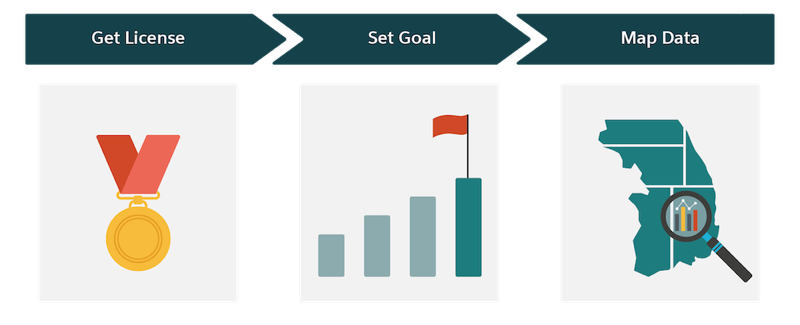
Get License
If you don’t have a license for Salesforce Maps, discuss your options with a Salesforce
account executive. Your account executive can help you determine whether it makes sense for
you to purchase:
Salesforce Maps as an add-on to Sales, Service, or an industry-specific offering such as
Financial Services, Healthcare, or Manufacturing
Retail Execution in Consumer Goods, which comes standard with Salesforce Maps
Set Goal
Develop a healthy pipeline of prospects that supplements your regular lead sources.
Using Salesforce Maps data, you can create leads or accounts for the properties and
businesses that you want to pursue.
If you’re looking to expand your business into or
recruit from untapped and underserved markets, determine which population characteristics
are more likely to respond to your offerings. For example, you want to focus on counties
with high populations and concentrations of households earning income within specific
brackets.
Map Data
Create data layers that you plot in Salesforce Maps. When you identify the data that
represents the properties and businesses that you want to pursue, you create leads using
Click2Create in Salesforce Maps.
If you’re working with demographic data, you visualize
areas on the map that offer greater potential for expanding your business or recruiting
talent efficiently.
We use three kinds of cookies on our websites: required, functional, and advertising. You can choose whether functional and advertising cookies apply. Click on the different cookie categories to find out more about each category and to change the default settings.
Privacy Statement
Required Cookies
Always Active
Required cookies are necessary for basic website functionality. Some examples include: session cookies needed to transmit the website, authentication cookies, and security cookies.
Functional Cookies
Functional cookies enhance functions, performance, and services on the website. Some examples include: cookies used to analyze site traffic, cookies used for market research, and cookies used to display advertising that is not directed to a particular individual.
Advertising Cookies
Advertising cookies track activity across websites in order to understand a viewer’s interests, and direct them specific marketing. Some examples include: cookies used for remarketing, or interest-based advertising.