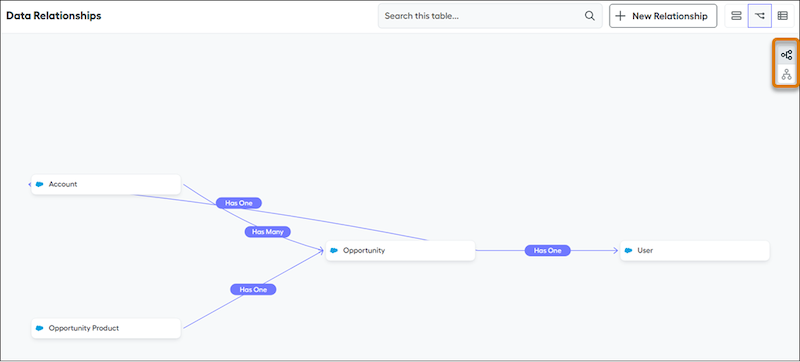
Salesforce Spiff organizes data used for calculating commissions in multiple separate tables. To calculate commission logic correctly or create data filters, establish relationships between tables. A relationship requires a field in each table with a common value. For example, to connect Deals with Accounts, the values of the Deals table's CustomerAccount field match the values of the Accounts table's external_id field.
Required Editions
Available in: both Salesforce Classic (not available in all orgs) and Lightning
Experience
Available in: Enterprise, Unlimited, and Developer
Editions
Available for an additional cost in: Professional Edition with Web
Services API Enabled
Tip You don't need to establish a relationship for every association between tables. Only establish a relationship for commission logic and data filters.
Each relationship is one-way, so the CustomerAccount field on the Deals table represents a one-way relationship from Deals to Accounts. To create a reciprocal relationship from Accounts to Deals, establish a separate relationship. You can reuse the same fields in both directions.
A relationship can be one-to-one, one-to-many, or many-to-many.
To view established relationships in Spiff, go to the Data tab in Designer and click Data Relationships. The relationship map visualizes your related tables and shows the type of each relationship. In the map, you can rearrange objects and switch between horizontal and vertical views.
Viewing Related Records from a Datasheet in Salesforce Spiff The View Related Records option on a record in a Salesforce Spiff datasheet shows you the record’s relationships to records on other objects. You can also access a related record from the Fields tab under Data.
We use three kinds of cookies on our websites: required, functional, and advertising. You can choose whether functional and advertising cookies apply. Click on the different cookie categories to find out more about each category and to change the default settings.
Privacy Statement
Required Cookies
Always Active
Required cookies are necessary for basic website functionality. Some examples include: session cookies needed to transmit the website, authentication cookies, and security cookies.
Functional Cookies
Functional cookies enhance functions, performance, and services on the website. Some examples include: cookies used to analyze site traffic, cookies used for market research, and cookies used to display advertising that is not directed to a particular individual.
Advertising Cookies
Advertising cookies track activity across websites in order to understand a viewer’s interests, and direct them specific marketing. Some examples include: cookies used for remarketing, or interest-based advertising.