
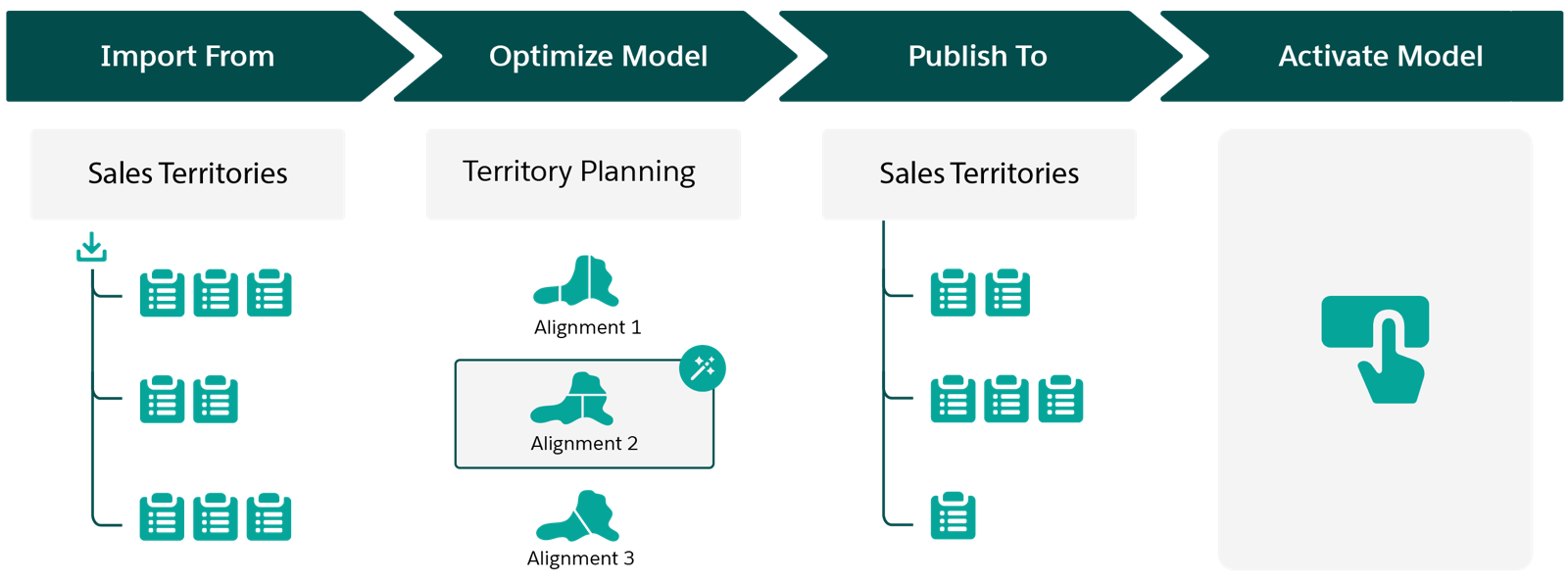
Account for staffing, leadership, and economic changes while you ensure the best
coverage for your company’s accounts, leads, and opportunities. Optimize your model by fine-tuning
assignment rules, redistributing work with consideration for skill levels and tenure, or balancing
territories, all in Territory Planning. Publish your optimized model to Sales Territories, and
then activate it when you’re ready.
Required Editions
Available in: both Salesforce Classic (not available in all orgs) and Lightning
Experience
Available in: Enterprise, Performance, Unlimited, and
Developer Editions
Get an idea of what’s involved in planning and managing territories when you pair Territory
Planning, an add-on product, with Sales Territories. When economic changes and compelling events
impact your sales teams, optimize your territory model on a map in Territory Planning. Then
publish your optimized model to Sales Territories where you activate it. Here’s how.
High-Level Flow
How It Helps Your Business
Import model data from Sales Territories
Work with your established territory model and refine it based on your changing
needs.
Optimize territory models in Territory Planning
Reflect changes that affect your sales teams in your updated model.
Publish the optimized model to Sales Territories
Run assignment rules, review your updated assignments, and make any adjustments before
you activate your optimized territory model.
Activate your territory model
Apply the changes from your updated territory model.
Did this article solve your issue?
Let us know so we can improve!
Loading
Salesforce Help | Article
Cookie Consent Manager
General Information
Required Cookies
Functional Cookies
Advertising Cookies
General Information
We use three kinds of cookies on our websites: required, functional, and advertising. You can choose whether functional and advertising cookies apply. Click on the different cookie categories to find out more about each category and to change the default settings.
Privacy Statement
Required Cookies
Always Active
Required cookies are necessary for basic website functionality. Some examples include: session cookies needed to transmit the website, authentication cookies, and security cookies.
Functional Cookies
Functional cookies enhance functions, performance, and services on the website. Some examples include: cookies used to analyze site traffic, cookies used for market research, and cookies used to display advertising that is not directed to a particular individual.
Advertising Cookies
Advertising cookies track activity across websites in order to understand a viewer’s interests, and direct them specific marketing. Some examples include: cookies used for remarketing, or interest-based advertising.