Context variables for the contact are included, but you can create any type of context
variable to use in your bot implementation. Use context variables for product names, store
locations, referral URLs, or items in a customer’s shopping cart.
Custom context variables can be linked to multiple channels and objects. The Chat channel can
map to the LiveChatTranscript object and the Messaging Channels can map from either the
MessagingSession or MessagingUser objects.
Deleting mappings on custom context variables affect functionality. We recommend that you note
where custom context variables are used to prevent data loss or showing merged fields inside a
conversation.
Start with a deactivated bot. If your bot is active, click
Deactivate.
In the Bot Builder menu, select Variables.
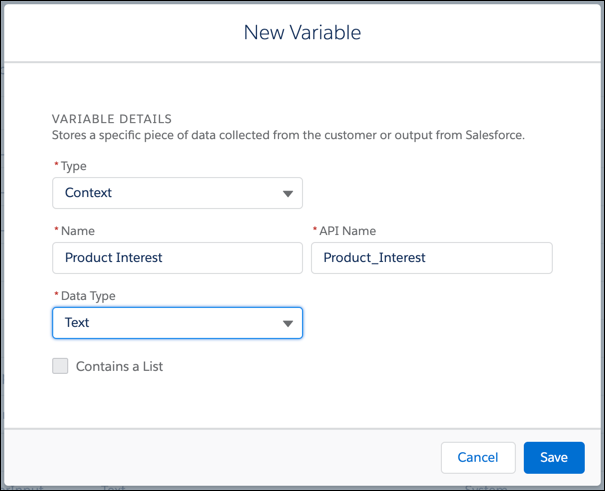
To create a variable, click New. Set the type to Context and give it
a name and Data Type. Save your changes.
Note Custom context variables must have a Data Type
of Text, Number, or ID.
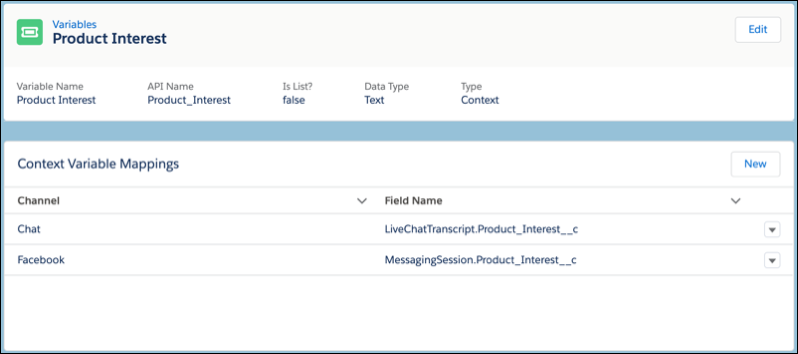
To open the variable detail page, click the variable name. To create a variable mapping,
click New.
To map to the variable, select the Channel and the Field. Save your changes. The mapping
shows with the channel and the API name of the mapped field.
Did this article solve your issue?
Let us know so we can improve!
Loading
Salesforce Help | Article
Cookie Consent Manager
General Information
Required Cookies
Functional Cookies
Advertising Cookies
General Information
We use three kinds of cookies on our websites: required, functional, and advertising. You can choose whether functional and advertising cookies apply. Click on the different cookie categories to find out more about each category and to change the default settings.
Privacy Statement
Required Cookies
Always Active
Required cookies are necessary for basic website functionality. Some examples include: session cookies needed to transmit the website, authentication cookies, and security cookies.
Functional Cookies
Functional cookies enhance functions, performance, and services on the website. Some examples include: cookies used to analyze site traffic, cookies used for market research, and cookies used to display advertising that is not directed to a particular individual.
Advertising Cookies
Advertising cookies track activity across websites in order to understand a viewer’s interests, and direct them specific marketing. Some examples include: cookies used for remarketing, or interest-based advertising.