
You are here:
Overview and Key Concepts
Customer Signals Intelligence (CSI) gives you an understanding of your customer's experience by turning all the fragmented interaction data into a unified source of truth.
Required Editions
| Available in: Lightning Experience |
| Available in: Enterprise, Performance, and Unlimited Editions with Data 360 and the Customer Signals Intelligence add-on |
By centralizing disparate touchpoints, it empowers businesses to gauge:
- Customer Sentiment: Understanding the emotional tone of customer interactions (positive, negative, neutral, mixed).
- Contact Reasons: Identifying recurring themes and subjects discussed by customers.
CSI also provides a comprehensive dashboard to visualize and interact with these insights, empowering businesses to make data-driven decisions to enhance Customer Signals.
Here’s a look at how data flows in CSI:
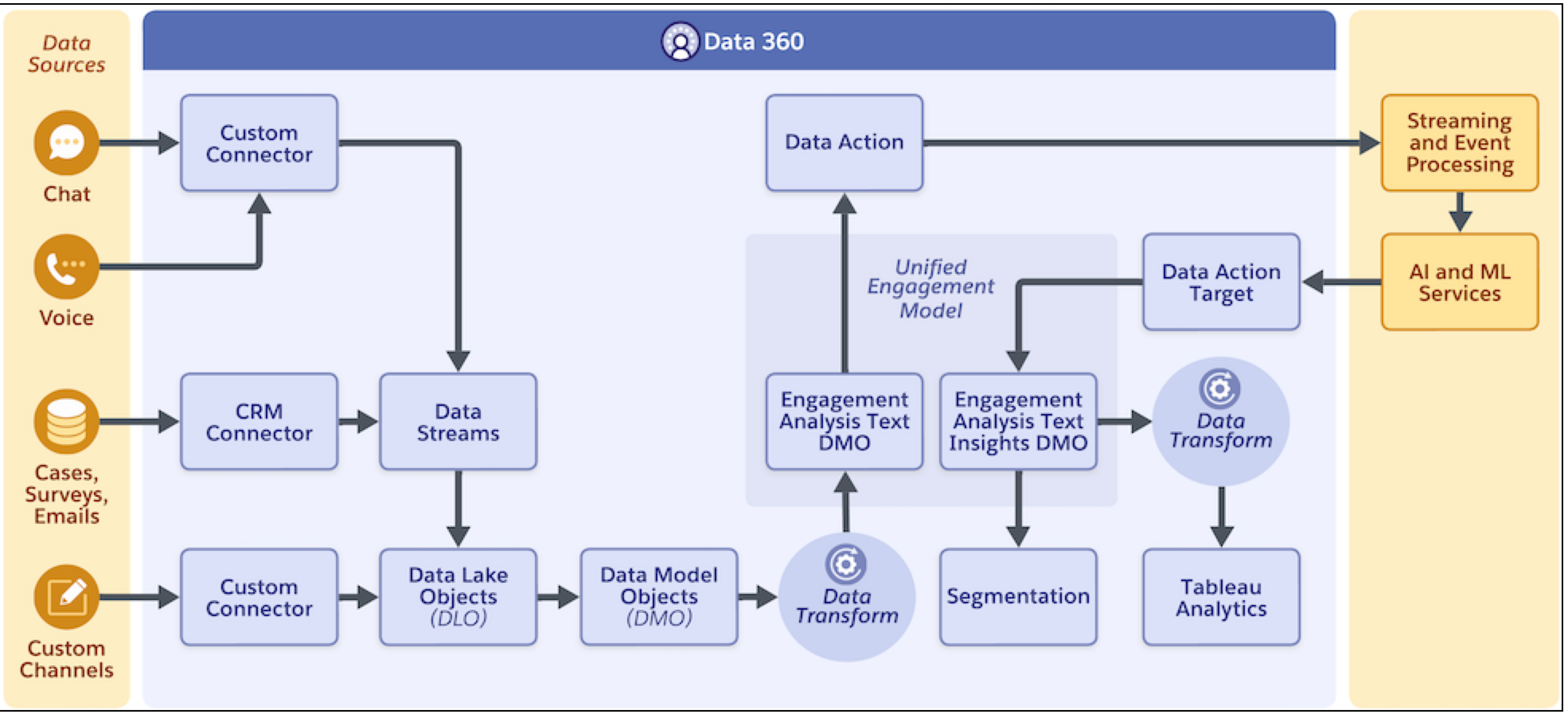
- Ingest: Data is ingested from various Salesforce touchpoints via CRM connectors (for example, cases, emails, surveys) and custom connectors (chat, voice) into Data 360. Credits are utilized only while ingesting data from third-party sources.
- Transform: In Data 360, the raw interaction data is transformed and normalized into a consistent format and the output is stored as records in the Engagement Analysis Text object.
- Analyze: From Data 360, Engagement Analysis Text records are pushed to a streaming service to generate insights using a Large Language Model (LLM) or Small Language Model (SLM). The insights are ingested back into Data 360.
- Visualize: The generated insights are then presented in an intuitive dashboard within Data 360, so that you can easily explore trends, identify patterns, monitor metrics, and trigger actions.
Here are some key concepts for CSI:
- Channel: Any method or avenue through which a business interacts with its customers to market products, facilitate sales, or provide support. For example, email, phone, live chat, SMS, social media (for example, WhatsApp, Facebook, X).
- Insights: Deep, actionable understandings of customers derived from analyzing data (behavior, transactions, feedback) to reveal their needs, motivations, and patterns. The insights generated in CSI are contact reasons, targeted sentiment, sentiment, entity, key phrase, and product.
- Agent Action: Actions are how agents get things done. Agents include a library of actions, which are the tools an agent can use to do its job. For example, if a user asks an agent for help with writing an email, the agent first selects a topic, then it launches an action that drafts and revises the email and grounds it in relevant Salesforce data.
- Contact Reason Insights: Identify contact reasons or themes in customer behavior for insights into preferences. For example, if customers frequently complain of calls being dropped, the contact reason is dropped calls.
- Targeted Sentiment Insights: When multiple aspects are included in customer interaction, sentiment is associated to specific objects. For example, the flight was delayed but the food was good. The delay is associated with a negative sentiment and the food is associated with a positive sentiment.
- Sentiment Insights: Measure the overall sentiment of customers for a product or service. For example, the flight was on time. The sentiment insights generated are positive.
- Entity Insights: Identify and categorize specific information from customer interactions or feedback. For example, product and customer names.
- Key Phrase Insights: Extract the most important phrases from a text to summarize key points or reasons for contact from customer feedback. For example, the experience was not great due to appalling service. Here the key phrase is appalling service.
- Product Insights: Extract actionable insights from customer feedback, including sentiment towards the product, positive and negative features mentioned in customer reviews, and the reasons customers contacted support. Products are identified based on the products uploaded in the Product DMO. Products are identified from the interactions and mapped to the uploaded products in the DMO and the sentiment is matched.
- Clustering: A machine learning technique used to group a set of objects in such a way that objects in the same group (called a cluster) are more similar to each other than to those in other groups. In CSI, contact reasons are grouped into clusters.
Did this article solve your issue?
Let us know so we can improve!
