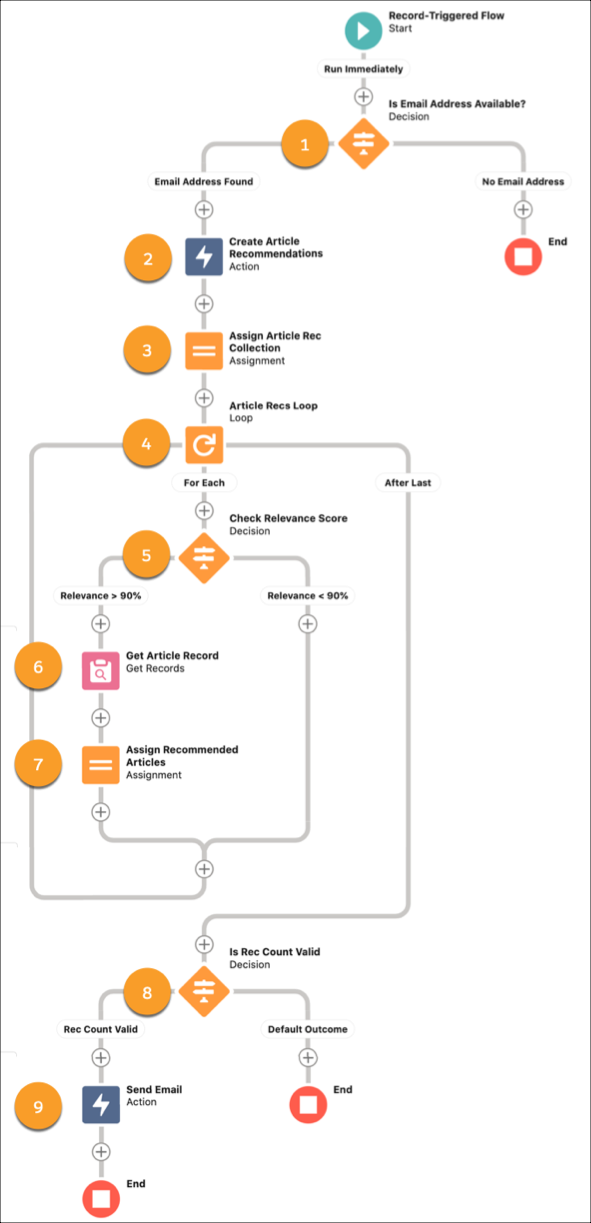
In this example flow, we verify there’s a valid email address (1), create the article
recommendations (2), assign the recommendations to a collection variable (3), loop over the
items in the collection (4), get the recommended knowledge article version (6), and assign it
to a text variable (7).
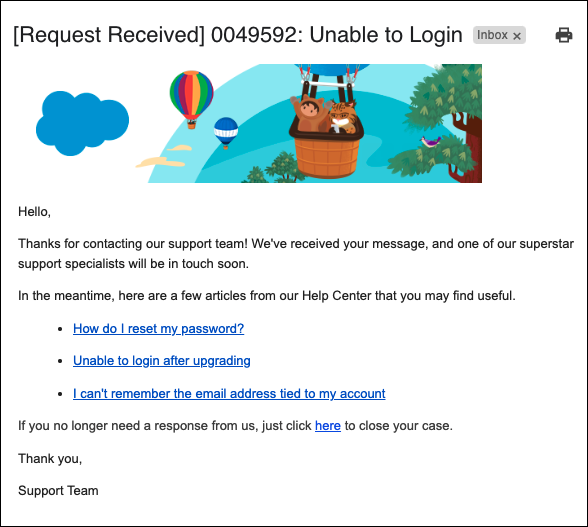
Next, these recommendations are automatically sent in an email template (9). Use text templates
to include merge fields from the articles and to add rich formatting to customize emails sent
via the flow. Visit Salesforce Help to learn how to use text templates in a
flow.
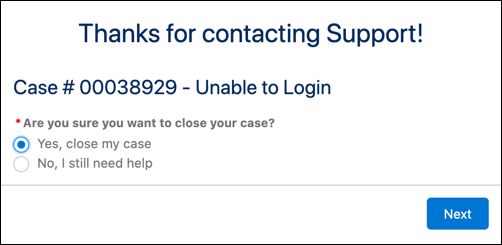
If your customers resolve their issue from the recommended knowledge articles, you can embed a
link to a second flow that updates and closes their case record.
In the example flow, several checks verify that: there’s a valid email address (1), the
identified knowledge articles meet the relevance threshold (5), and at least one knowledge
article is included in the email (8).
We use three kinds of cookies on our websites: required, functional, and advertising. You can choose whether functional and advertising cookies apply. Click on the different cookie categories to find out more about each category and to change the default settings.
Privacy Statement
Required Cookies
Always Active
Required cookies are necessary for basic website functionality. Some examples include: session cookies needed to transmit the website, authentication cookies, and security cookies.
Functional Cookies
Functional cookies enhance functions, performance, and services on the website. Some examples include: cookies used to analyze site traffic, cookies used for market research, and cookies used to display advertising that is not directed to a particular individual.
Advertising Cookies
Advertising cookies track activity across websites in order to understand a viewer’s interests, and direct them specific marketing. Some examples include: cookies used for remarketing, or interest-based advertising.