The Field Service Mobile App Builder user interface makes configuring navigation tabs
easy.
Required Editions
Available in: both Salesforce Classic (not available in all orgs) and Lightning
Experience
The Field Service core features, managed package, and mobile app are available in
Enterprise, Unlimited, and Developer Editions.
To access the Field Service mobile app, users need the Field Service Mobile user
license.
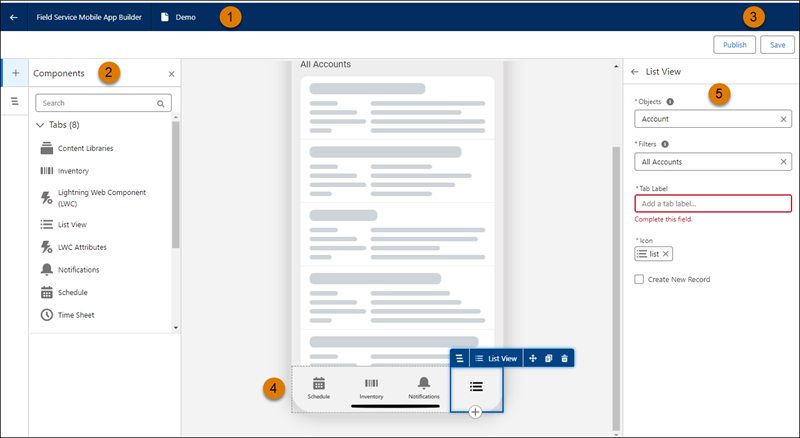
Here’s a breakdown of the parts of the tool.
The header shows you the label of your page. From here you can return to Setup without saving
by clicking the Back arrow. (1)
The component palette lets you drag components onto the canvas to create tabs. (2)
In the status bar, you can check whether your configuration is active or a draft, see when it
was last modified, and publish or save. (3)
The page canvas area is a preview of your screen. Click the tab to copy, delete, or move the
tab. Clicking the tab also brings up properties to edit in the Properties pane.(4)
Edit tab details in the Properties pane. Click a tab in the canvas to see that component’s
options in the Properties pane. (5)
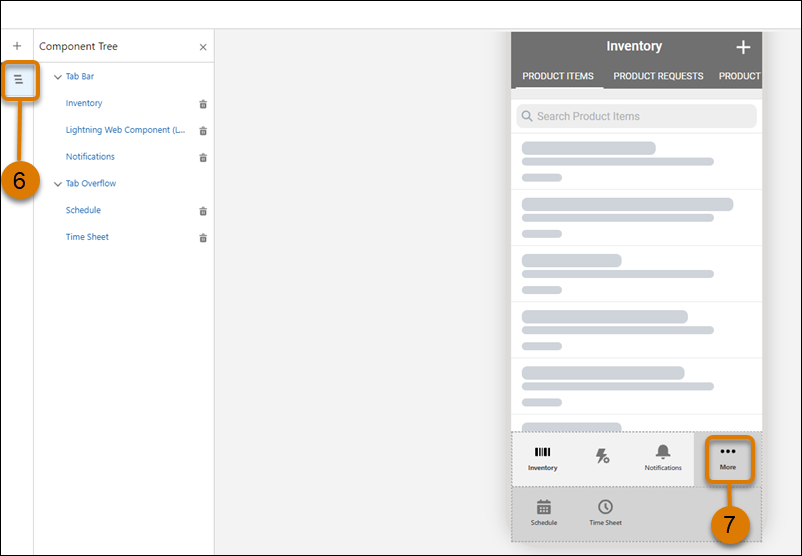
Clicking the component tree toggle lets you see your selected components. From here, you can
interact with a component and delete it. You can also easily see if you have components in the
tab overflow area, which are available when a user taps More in the app.
The overflow area activates when you have more than 4 tabs in the app.
Did this article solve your issue?
Let us know so we can improve!
Loading
Salesforce Help | Article
Cookie Consent Manager
General Information
Required Cookies
Functional Cookies
Advertising Cookies
General Information
We use three kinds of cookies on our websites: required, functional, and advertising. You can choose whether functional and advertising cookies apply. Click on the different cookie categories to find out more about each category and to change the default settings.
Privacy Statement
Required Cookies
Always Active
Required cookies are necessary for basic website functionality. Some examples include: session cookies needed to transmit the website, authentication cookies, and security cookies.
Functional Cookies
Functional cookies enhance functions, performance, and services on the website. Some examples include: cookies used to analyze site traffic, cookies used for market research, and cookies used to display advertising that is not directed to a particular individual.
Advertising Cookies
Advertising cookies track activity across websites in order to understand a viewer’s interests, and direct them specific marketing. Some examples include: cookies used for remarketing, or interest-based advertising.