
You are here:
Use an Existing Amazon Connect Instance Integrated by Salesforce
Set up your Service Cloud Voice contact center with your existing Amazon Connect instance. Let Salesforce Help you integrate Voice with your existing Amazon Connect instance. Choose this option if you have an AWS account and an Amazon Connect instance you want to use with Voice.
Required Editions
This article applies to:
- Service Cloud Voice with Partner Telephony from Amazon Connect
| View supported editions. |
With this option, Salesforce assumes an AWS IAM role on your behalf to integrate Voice with Amazon Connect. Voice reuses your Amazon Connect instance’s S3 bucket, contact record data stream, Kinesis video stream, and Contact Lens stream.

Before integrating Voice with your existing Amazon Connect instance, ensure that you have one of the Hours of operation as Basic Hours in your Amazon Connect instance.
Service Cloud Voice with Partner Telephony from Amazon Connect supports Amazon Connect instances of type SAML only.
You must ensure that you have all the required resources such as S3 bucket, contact record data stream, Kinesis video stream, and Contact Lens stream in your AWS account. Also, after creating your Amazon Connect instance, you must not delete these configured resources from your AWS account.
If you have any edition of the older (legacy) Service Cloud Voice - LP product, the same steps are also applicable for integrating Voice with your Amazon Connect instance.
- From Setup, enter Partner Telephony in the Quick Find box, then select Partner Telephony Contact Centers.
- Click Create Contact Center.
- Specify Amazon Connect as the telephony provider.
-
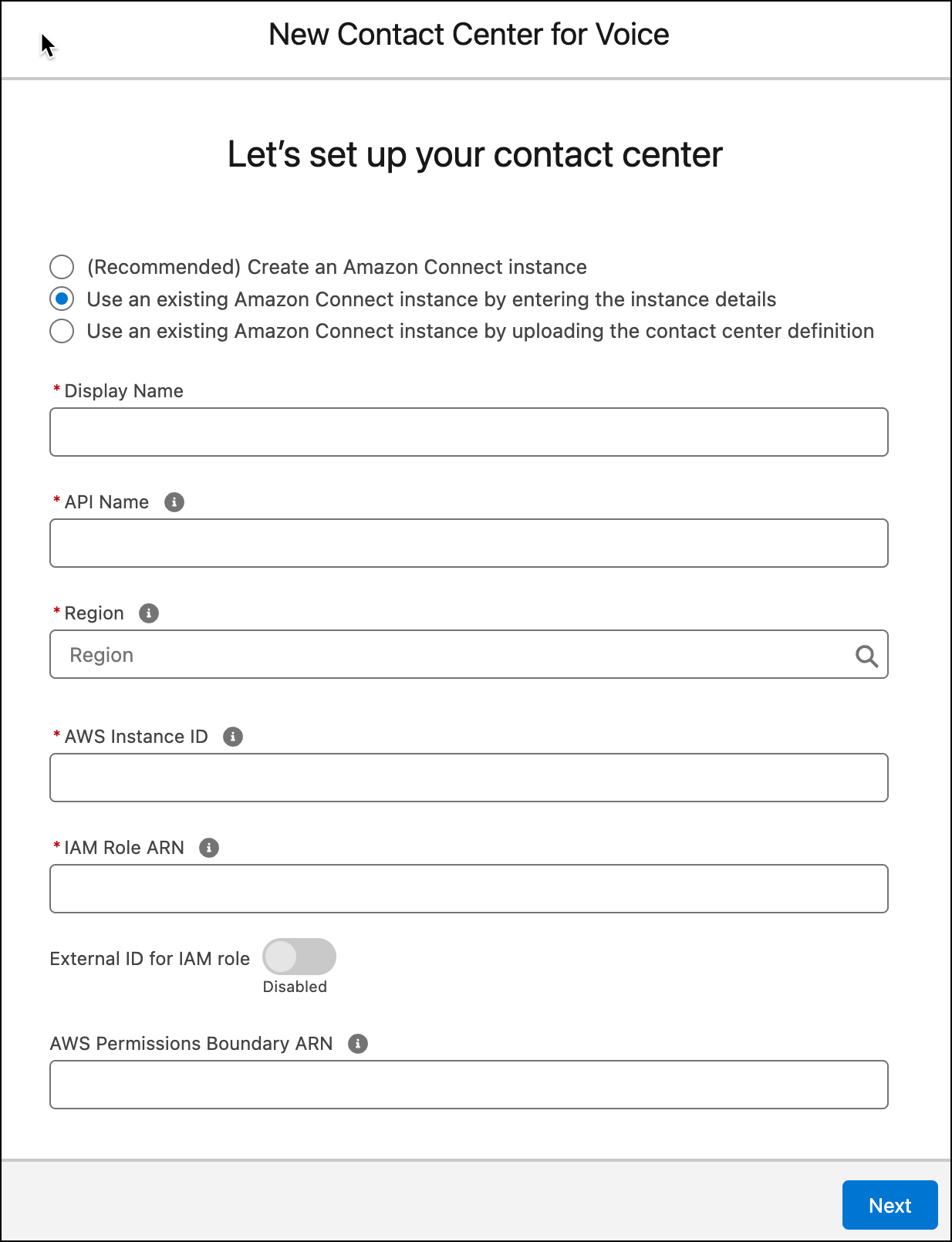
Select Use an existing Amazon Connect instance by entering the instance
details.
-
Enter the contact center and AWS details.
- Enter a display name for your contact center.
- Enter an internal name for your contact center. The internal name is how other objects recognize your call center, similar to an API name. The internal name must be unique to your org, contain fewer than 20 characters, start with a letter, and contain only alphanumeric characters.
-
Select the same AWS region where your Amazon Connect instance is located. The list
is populated with the AWS regions that support Amazon Connect.
If you operate in the public sector domain in the US, when you create a contact center, the list is populated with the AWS GovCloud regions for compliance. The supported AWS GovCloud regions are specified in Amazon Documentation.
-
Enter the instance ID of your existing Amazon Connect instance.
You can get the instance ID from your AWS Console. The instance ID is the characters after
instance/in the instance ARN.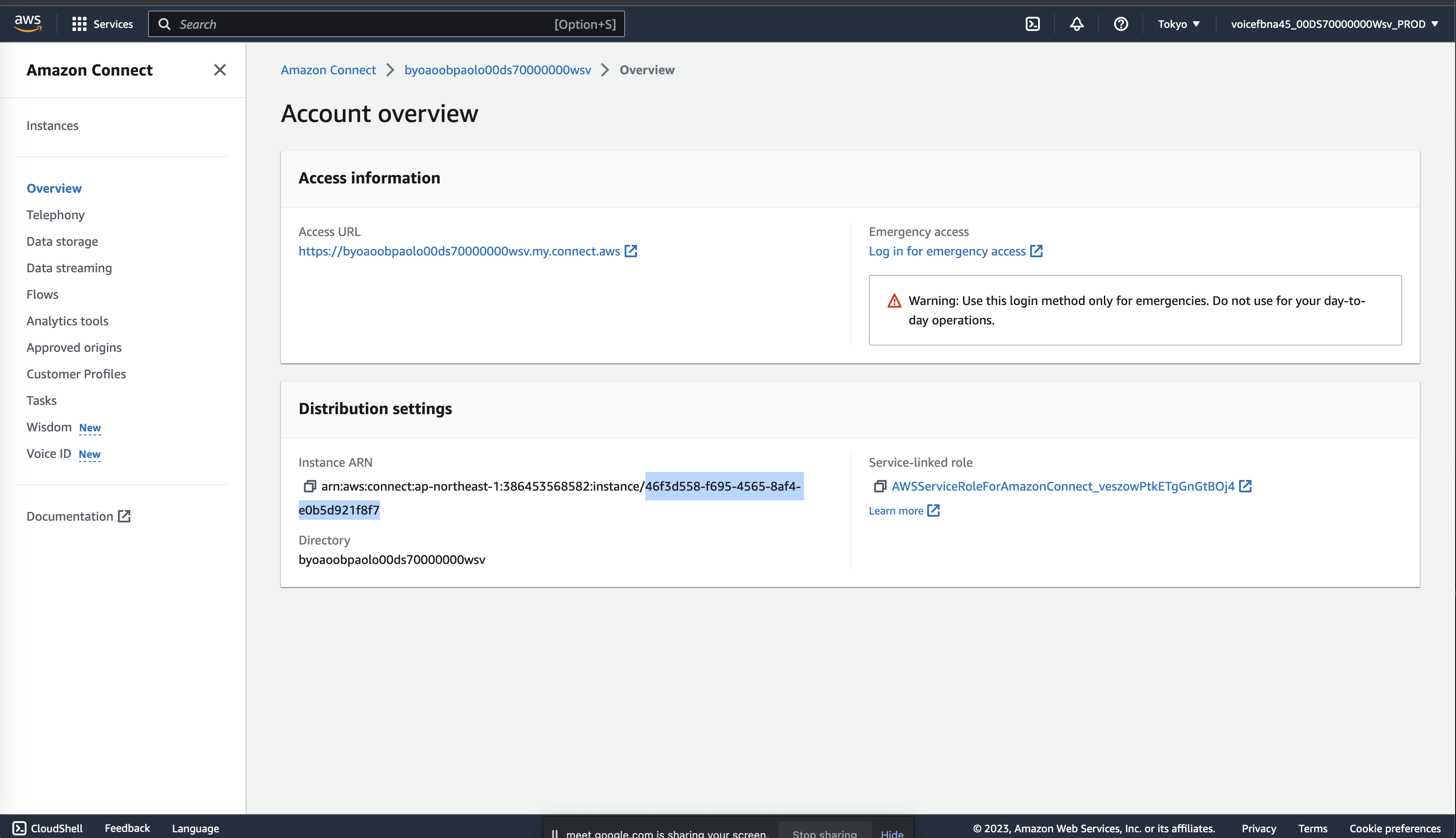
-
Enter the ARN of the IAM role that you created earlier. Salesforce uses this IAM
role to access your Amazon Connect instance to automatically build out your contact
center. You can also enable external ID for the AWS account associated
with the IAM role ARN.
You can enable external ID only if you have not created any other contact centers in this org with this AWS account.
- If AWS permissions boundaries are enforced for the IAM role, enter the AWS permissions boundary Amazon Resource Name (ARN) for the role. If set, the permissions boundary policy is attached to each IAM role that’s created during contact center provisioning.
-
Click Next. If you enable the external ID option for the IAM
role ARN in the previous step, you must generate the External ID for the AWS account
associated with the IAM role ARN. Then, add the generated external ID in the Trusted
Relationships in your AWS account. In your AWS account, the external ID must be added in
the
provisioningrolejson file corresponding to the IAM role ARN.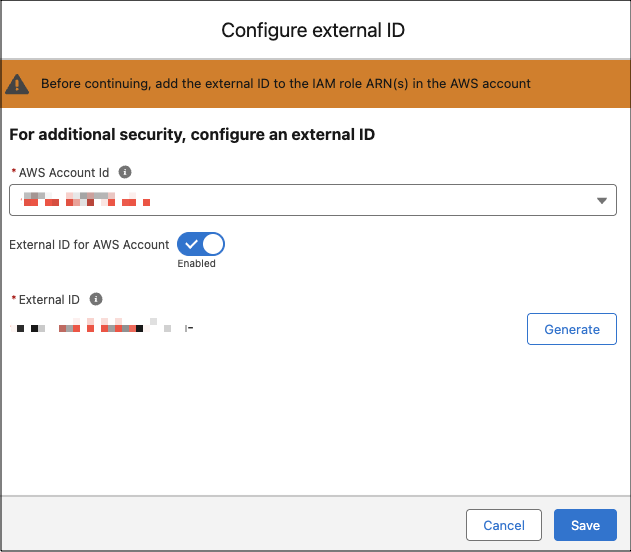
-
Optionally, select users that you want to add to your Amazon Connect instance.
The list is populated with users who already have the Contact Center Admin permission set.
-
Click Done.
It can take a few minutes to create the contact center.
- To manage the contact center after it’s created, under Setup, enter Partner Telephony Contact Centers in the Quick Find box, and select Partner Telephony Contact Centers.
