The process for setting up desk phones or headphones varies based on your telephony
provider. Work with your telephony provider to get the procedure. The following procedure
applies to the Amazon Connect telephony provider only.
Log in to the AWS Management Console, click Services, and then click
Amazon Connect.
Click the Amazon Connect instance that matches the name of your Service Cloud Voice contact center.
Click Users and then User management.
Select the users you want to grant desk phone access. Click
Edit.
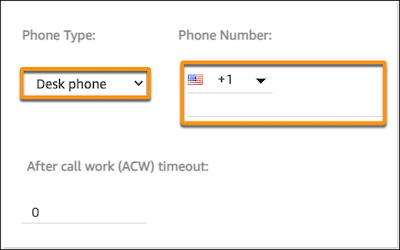
Select Desk phone as the Phone Type and enter the phone
number.
Save your changes.
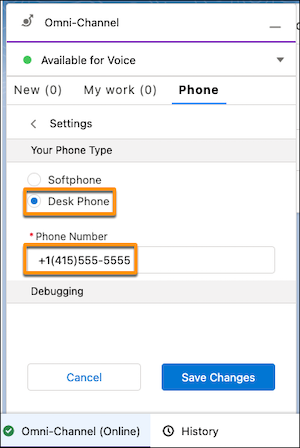
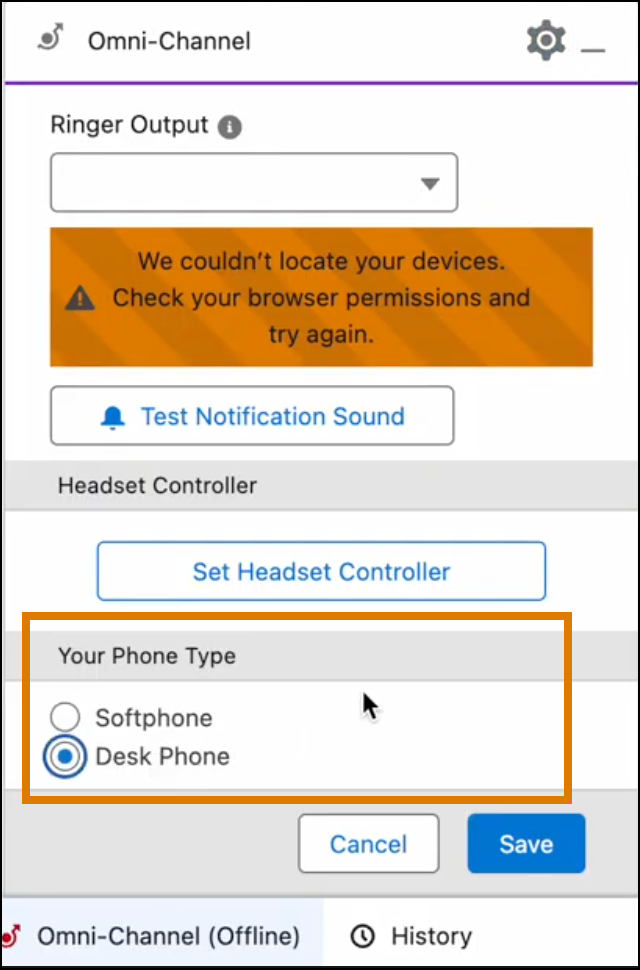
After you set up desk phone functionality, reps can select desk phone from the
Omni-Channel utility.
When you enable a desk phone for Service Cloud Voice with Amazon Connect or Service
Cloud Voice with Partner Telephony from Amazon Connect, the mute, accept, and decline
functionality is disabled in the Omni-Channel utility. Reps must perform these actions from
the desk phone.
When you enable a desk phone for Service Cloud Voice with Partner
Telephony, Omni-Channel utility functionality depends on the partner telephony provider’s
integration. To confirm expected behavior, check with your partner telephony
provider.
Did this article solve your issue?
Let us know so we can improve!
Loading
Salesforce Help | Article
Cookie Consent Manager
General Information
Required Cookies
Functional Cookies
Advertising Cookies
General Information
We use three kinds of cookies on our websites: required, functional, and advertising. You can choose whether functional and advertising cookies apply. Click on the different cookie categories to find out more about each category and to change the default settings.
Privacy Statement
Required Cookies
Always Active
Required cookies are necessary for basic website functionality. Some examples include: session cookies needed to transmit the website, authentication cookies, and security cookies.
Functional Cookies
Functional cookies enhance functions, performance, and services on the website. Some examples include: cookies used to analyze site traffic, cookies used for market research, and cookies used to display advertising that is not directed to a particular individual.
Advertising Cookies
Advertising cookies track activity across websites in order to understand a viewer’s interests, and direct them specific marketing. Some examples include: cookies used for remarketing, or interest-based advertising.