
You are here:
Workflow
Learn how data flows through the configurations when you use the Salesforce Consent Data Model to manage and respect consent preferences in Marketing Cloud Engagement. For this solution kit, we consider a scenario where contact point information ties to a Contact record.
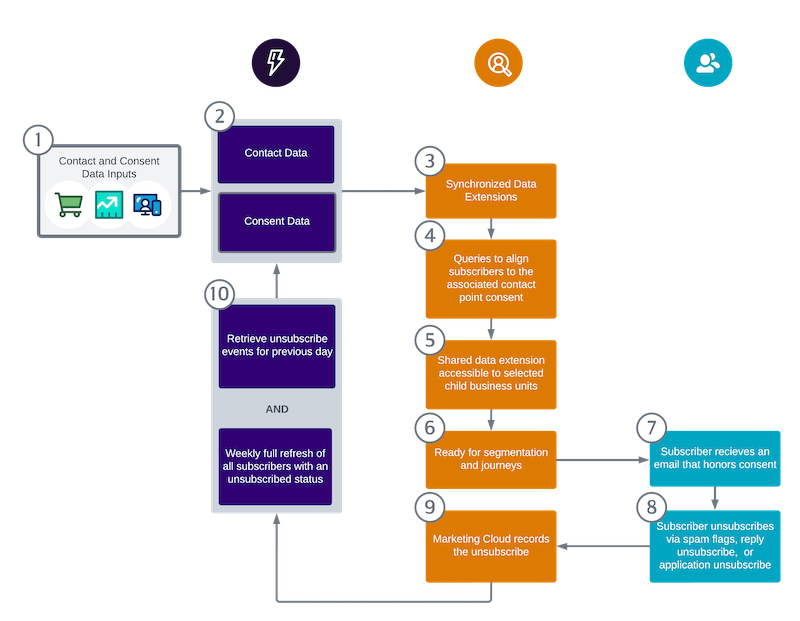
- Individual contact and consent data is created in the Salesforce Consent Data Model from a point of sale (POS) entry or account creation on Experience Cloud. It can also be captured from a custom profile page in Commerce Cloud during purchases. For example, from a POS entry, account creation process, or a preference page for a consumer’s profile. (1)
- Contact data is stored against any object that relates to the Individual object, including Lead, User, Person Account, and Contact. Consent data is stored in consent management objects, including Individual, Contact Point Type Consent, Contact Point Consent, and Data Use Purpose objects. (2)
- Contact and consent data is synchronized to Engagement via Marketing Cloud Connect to Synchronized Data Extensions. (3)
- Queries are created to relate subscribers to the associated contact point consent record, identifying which consent records relate to which subscribers. (4)
- A shared data extension is created and exposed to the required child business unit. (5)
- Contact data is now aligned to related consent data and is ready for marketing use and activation. (6)
- Subscribers receive an email that honors consent. (7)
- Subscribers can unsubscribe using spam flags, reply unsubscribe, or application unsubscribe. (8)
- Engagement stores the unsubscribe on the All Subscribers list. (9)
- Two processes monitor for unsubscribe events in Engagement and return the consent
signal to the Salesforce Consent Data Model. (10)
- Flow initiates an API call to Engagement to retrieve the unsubscribe events for the previous day.
- A weekly refresh process retrieves all subscribers with an unsubscribed status.
Related Content

|
Review earlier steps in this solution. |

|
Take the next steps in this implementation. |
Did this article solve your issue?
Let us know so we can improve!
