
You are here:
What's Education Data Architecture (EDA)?
Education Data Architecture is a community-driven data architecture designed to help educational institutions use Salesforce out-of-the-box.
EDA standardizes the starting point for educational institutions building out a CRM. It provides a core and common data model that supports the entire K-20 student journey. It's an open source architecture—anyone can view the source code in GitHub. It's been developed in close collaboration with our customers, partners, and the K-20 community to foster common acceptance. Solutions built on EDA share the same open and flexible, extendable framework that accommodates a range of use cases and end-user customization. With EDA, you get an architecture along with preconfigured objects, logic and functionality, and automation, tailored for education right out of the box.
The EDA framework, supported by the Salesforce Platform, can serve as the foundation for managing data and data relationships across your entire institution, in departments like these:
Advising
Alumni and Advancement
Business Enablement (Housing, IT Help Desk, Facilities, Security)
Faculty
Finance
Marketing
Recruiting and Admissions
Registrar
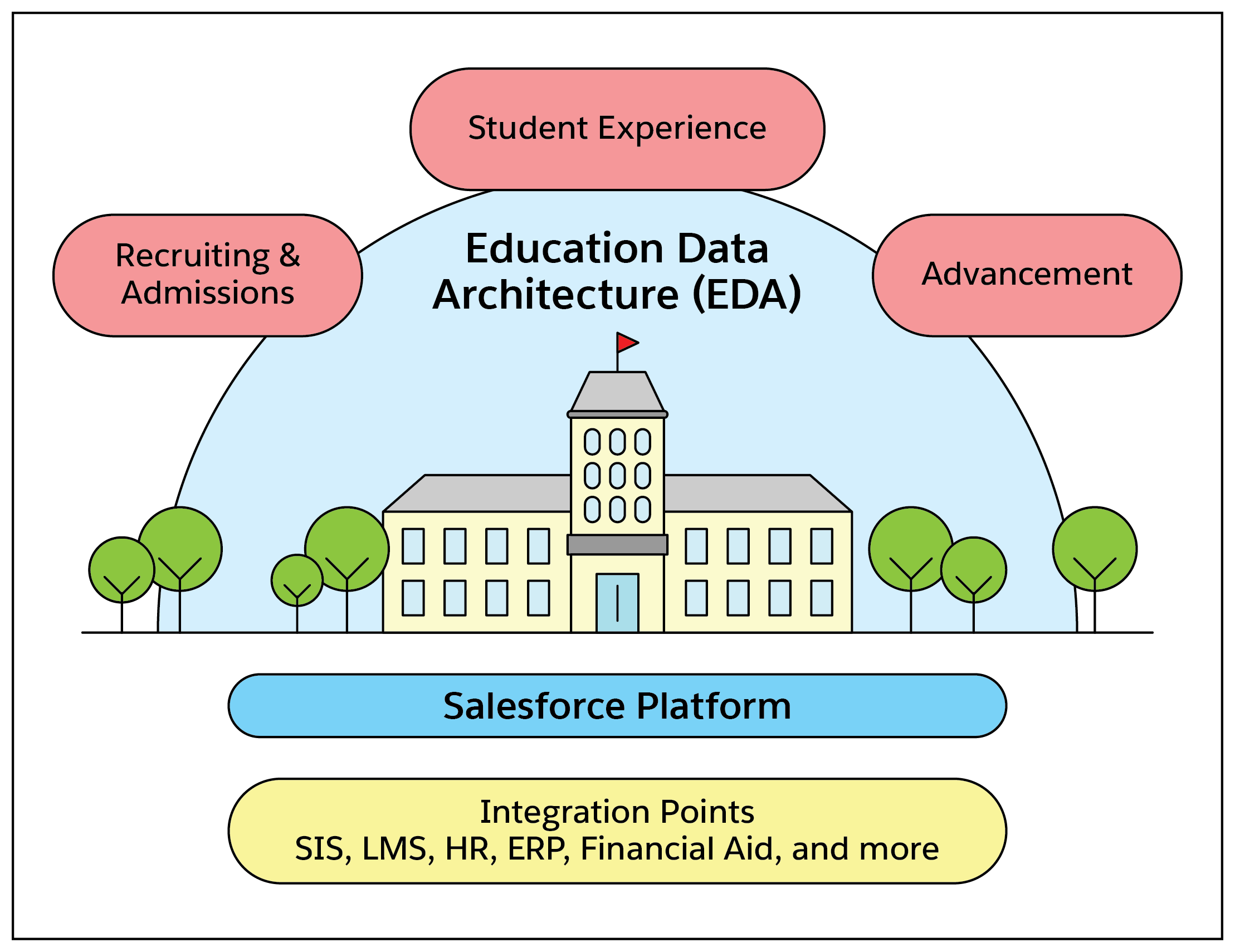
EDA can give your student-facing staff a consolidated, 360-degree view of who students are, where they come from, what their interests are, and who they interact with. Build out your architecture to easily see students':
- Relationships with other people, such as parents, advisors, or teammates
- Organizations they're related to, such as schools, academic departments, or sports organizations
- Courses and degree programs
- Address information, including seasonal addresses
- And much more . . .
You might adopt EDA on its own or as part of other Salesforce.org offerings. For example, Student Success Hub is built on EDA and enables a personalized, streamlined student experience with advising and other student services. Gift Entry Manager, also built on EDA, facilitates fundraising in advancement offices by tracking gifts, payments, and accounting data.
EDA is customizable for the many varied use cases we find in education. And, because it's built on the Salesforce Platform, your users can easily access the EDA app from mobile devices.
To be clear, EDA is neither a point solution nor a product in the traditional sense. It doesn't include functionality that's transactional or financial in nature, and it likely can't replace your LMS (Learning Management System) or SIS (Student Information System). Instead, it integrates with and complements those systems, providing a single place to track constituent information for that invaluable 360-degree view. Connecting all these data points around a student enables deeper, more meaningful engagement at every stage of the student journey.
For details about extending EDA with other solutions, see EDA Limitations and Extension Options.
As you get started, remember that you're not alone—institutions are ready to share EDA best practices and support. Join the Education Data Architecture Group today and join the conversation!
