
You are here:
Create a Batch
First, you need to define the configuration that will be used on only a selected set of records. To illustrate an example, we will create a batch for the upcoming event (that we mentioned earlier).

To create a new batch in NPSP:
- Click the App Launcher (
 ).
). - Click NPSP Data Import Batches.
- Click New.
- Fill in the required fields and any configuration options you want to apply specifically to this batch. When you select this batch in the NPSP Data
Importer, the configuration options are updated to show the values you select here.
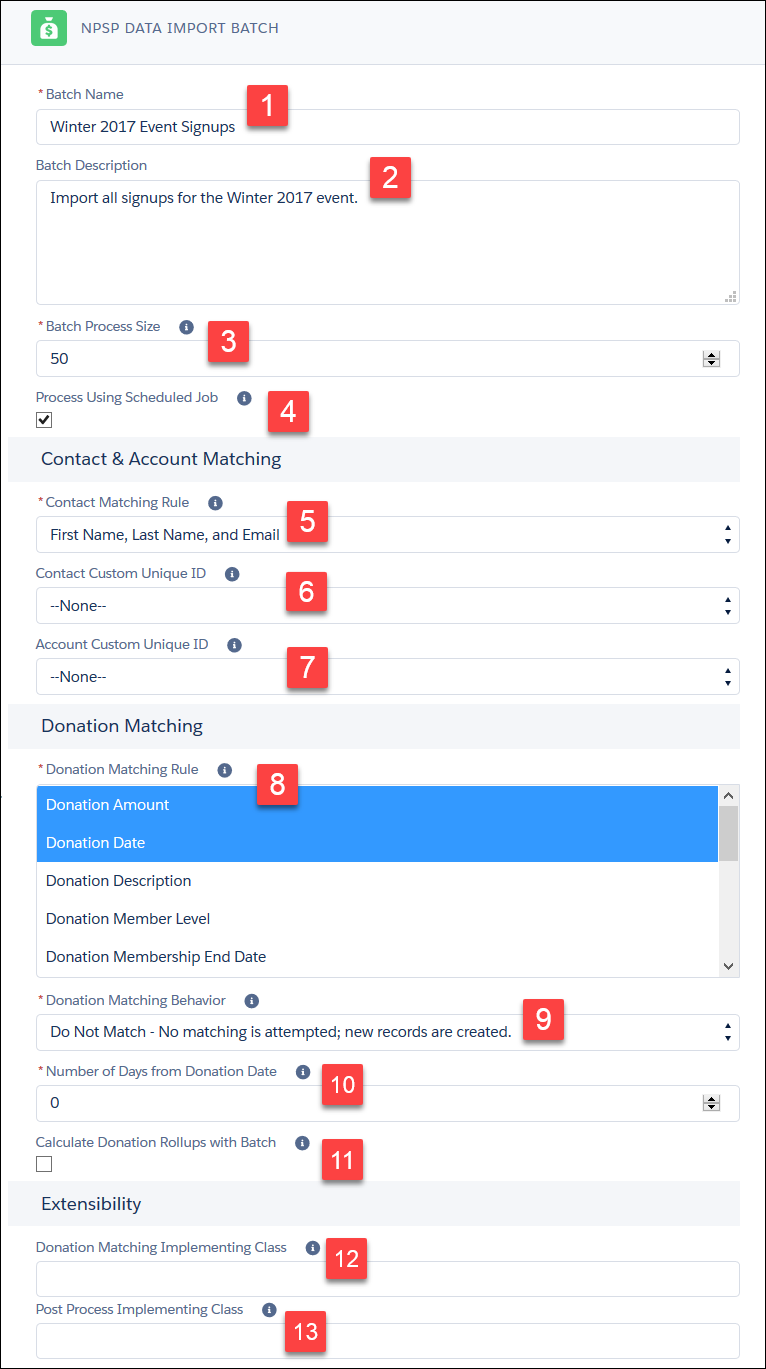
- Batch Name—(1) The name must be unique in your org. Be sure to use a descriptive name, since you will be searching for and selecting it when you perform your data import. (Tip: If you're using a scheduled job, you may want to name your batches "Company name - date" so that it's easier to find the right batch.)
- Batch Description—(2) An optional description of the batch.
- Batch Process Size—(3) The number of NPSP Data Import records you want Salesforce to process in each batch. The default is 50 records.
- Process Using Scheduled Job—(4) When checked, the batch will be processed each day based on the schedule outlined for the scheduled job. See Schedule a Batch for more details.
- Contact Matching Rule—(5) Specifies how to match Contacts in records against existing Contacts. The rules specify which set of Contact fields to use to find matches. For example: First Name, Last Name, and Email or First Name, Last Name, and Phone. (Keep in mind that the phone number format has to be an exact match. For example, if all of the phone numbers in your database are formatted as 123-345-4567, then you must use that format, not 123.345.4567 or 1233454567.) NPSP Data Import
- Contact Custom Unique ID—(6) This field can be any custom text or numeric field that uniquely identifies a Contact, and is used for matching Contacts in addition to the method specified in Contact Matching Rule. This option is useful if your external data source has a unique identifier for each Contact record. For example, you could add a custom field on Contact, such as MyOldID, and matching fields for Contacts in the NPSP Data Import object (Contact1_MyOldID, Contact2_MyOldID).
- Account Custom Unique ID—(7) This field can be any custom text or numeric field that uniquely identifies an Account, and is used for matching Accounts in addition to matching by Account Name. This option is useful if your external data source had a unique identifier for each Account record. For example, you could add a custom field on Account, such as MyOldID, and matching fields for Accounts in the NPSP Data Import object (Account1_MyOldID, Account2_MyOldID).
- Donation Matching Rule—(8) Specifies the set of Donation fields to use for matching against existing Opportunities and/or Payments. If no fields are selected, the Donation Date and Donation Amount fields are used. The Donation fields specified must map to either Opportunity fields or Payment fields (with the exception of Donation Amount, which maps to both Opportunity.Amount and Payment.Payment Amount, and Donation Date which maps to Opportunity.CloseDate and Payment.Scheduled Date).
- Donation Matching Behavior—(9) Defines how the Data Importer should handle matching Opportunities and Payments. Must be one of the following values:
- Do Not Match—No matching is attempted; new records are created.
- No Match—Only import a record if it doesn't match an existing record.
- Single Match—Only import a record if it matches a single existing record.
- Single Match or Create—Import a record if it matches a single existing record; create a new record if no single match found.
- Best Match—Only import a record when it matches at least one existing record, and update the best matched record.
- Best Match or Create—Import a record if it matches an existing record; create a new record if no match found.
 Important If you choose No Match, Single Match, or Best Match and the Data Importer can't match against an existing Opportunity or Payment, the status of the Data Import will show "Failed." However, any associated Account or Contact from the Data Import will still be created. You can evaluate the Opportunity or Payment that failed and rerun the Data Importer.
 - Number of Days from Donation Date—(10) Specifies the number of days to consider (from the Donation date) when looking for a matching Opportunity or Payment. The Data Importer will use the matching Opportunity or Payment that falls within the number of days specified AND is closest to the Donation Date.
- Calculate Donation Rollups with Batch—(11) When checked, NPSP calculates donor statistics when donations are processed as part of an NPSP Data Import Batch. If unchecked (the default), donor statistics are only calculated during the default nightly Scheduled Job. Note that selecting this checkbox may slow down processing of this batch.
- Donation Matching Implementing Class—(12) The full developer name of an Apex class that implements the BDI_IMatchDonations interface, in case you are working with a developer who would like to alter this behavior. When left empty, the NPSP default implementation is used.
- Post Process Implementing Class—(13) The full developer name of an Apex class that implements the BDI_IPostProcess interface, in case you are working with a developer who would like to alter this behavior. For more information, see Additional Automation Using Custom Apex Code.
- Click Save.
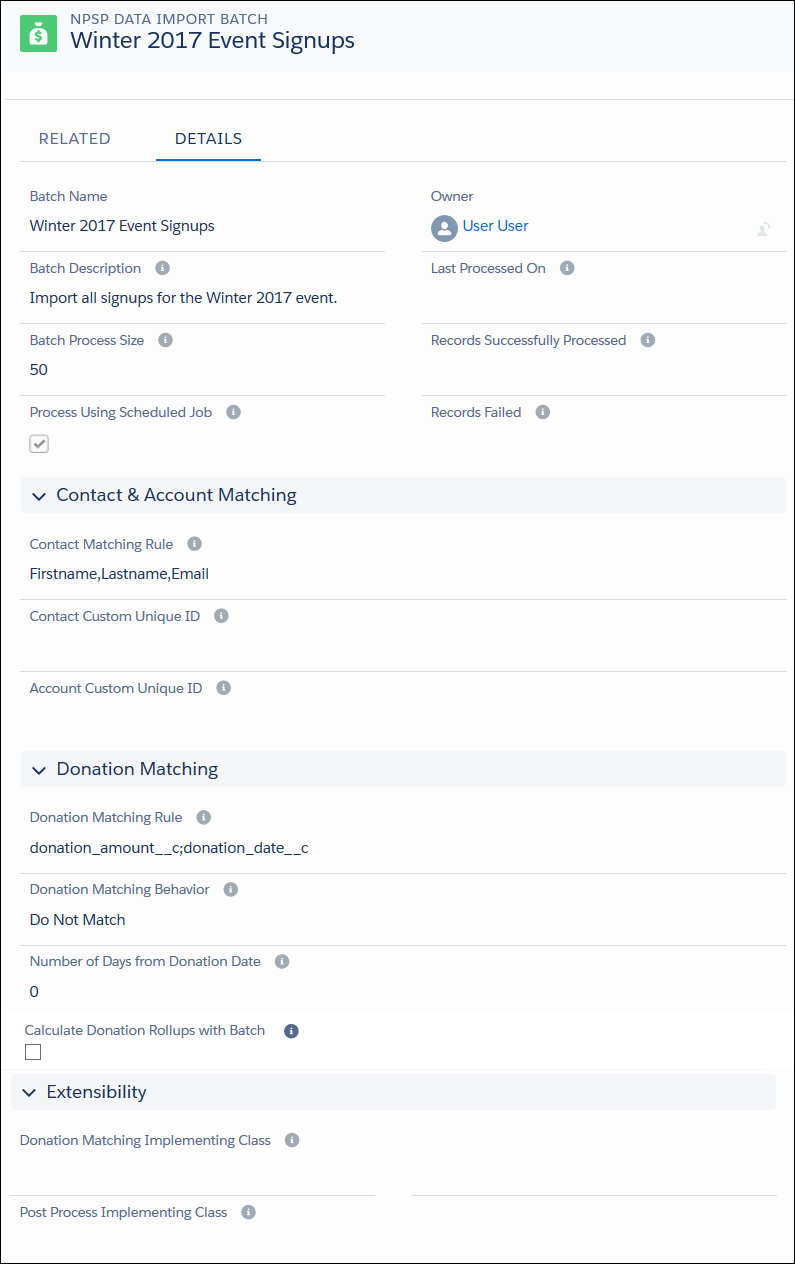
Next step: Create NPSP Data Import Records Connected to a Batch.
Did this article solve your issue?
Let us know so we can improve!
