
Data and Storage Resources
View your Salesforce org’s storage limits and usage from the Storage Usage page in Setup.
Required Editions
| Available in: both Salesforce Classic and Lightning Experience |
| Available in: All Editions |
| User Permissions Needed | |
|---|---|
| To view storage usage: | Manage Internal Users AND Manage Users |
Storage is divided into two categories. File storage includes files in attachments, Files home, Salesforce CRM Content, Chatter files (including user photos), the Documents tab, the custom File field on Knowledge articles, and Site.com assets. Data storage includes:
- Accounts
- Action Cadence
- Action Cadence Rule
- Action Cadence Rule Condition
- Action Cadence Step
- Action Cadence Step Tracker
- Action Cadence Step Variant
- Action Cadence Tracker
- Action Cadence Step Monthly Metric
- Article types (format: “[Article Type Name]”)
- Article type translations (format: “[Article Type Name] Version”)
- Campaigns
- Campaign Members
- Cases
- Case Teams
- Contacts
- Contracts
- Custom objects
- Data translations
- Email messages
- Engagement Attendee
- Engagement Interaction
- Engagement Topic
- Events
- Flow Interviews
- Forecast items
- Google docs
- Ideas
- Leads
- List Email
- Notes
- Opportunities
- Opportunity Splits
- Orders
- Quotes
- Quote Template Rich Text Data
- Solutions
- Tags: Unique tags
- Tasks
- All objects tied to Field Service enablement (for a full list, see the Field Service Developer Guide)
Data Storage
Starting in late March 2019, Contact Manager, Group, Essentials, Professional, Enterprise, Performance, and Unlimited Editions are allocated 10 GB for data storage, plus incrementally added user storage. Starter Edition is allocated 10 GB for data storage, plus incrementally added user storage. For example, a Professional Edition org with 10 users receives 10 GB of data storage, plus 200 MB, for 10.2 GB of total data storage.
Salesforce Order Management storage is counted separately from overall data. Order Management allocates 50 MB for managed orders and 50 MB for unmanaged orders that are in the Order Management SKU.
File Storage
Contact Manager, Group, Professional, Enterprise, Performance, and Unlimited Editions are allocated 10 GB of file storage per org. Essentials and Starter Editions are allocated 1 GB of file storage per org.
File storage and data storage are calculated asynchronously, so if you import or add a large number of records or files, the change in your org’s storage usage isn’t reflected immediately.
The minimum values apply to Salesforce and Salesforce Platform user licenses. If your org uses custom user licenses, contact Salesforce to determine your exact storage amount.
Big Object Storage
Contact Manager, Group, Enterprise, Performance, Unlimited, Developer, and Personal editions are allocated storage for 1 million big object records per org. Contact Salesforce to increase the limit. Big object storage is calculated asynchronously, so new records aren’t immediately reflected. While big object record limits aren’t actively monitored, Salesforce reserves the right to enforce the limit if necessary. In most cases, the allocation is enforced and records can’t be added when the allocation is exceeded. For active production orgs, the allocation of big object records is enforced contractually.
| Salesforce Edition | Data Storage Minimum per Org | Data Storage Allocation per User License | File Storage Allocation per Org |
|---|---|---|---|
| Contact Manager | 10 GB | 20 MB | 10 GB |
| Group | 10 GB | 20 MB | 10 GB |
| Professional | 10 GB | 20 MB | 10 GB |
| Enterprise | 10 GB | 20 MB | 10 GB |
| Performance | 10 GB | 120 MB 20 MB for Lightning Platform Starter user licenses |
10 GB |
| Unlimited | 10 GB | 120 MB 20 MB for Lightning Platform Starter user licenses |
10 GB |
| Developer | 5 MB | N/A | 20 MB |
| Personal | 20 MB (approximately 10,000 records) | N/A | 20 MB |
| Essentials | 10 GB | N/A | 1 GB |
| Starter | 10 GB | N/A | 1 GB |

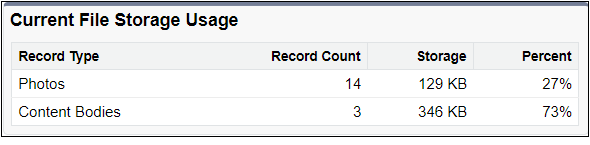
Notice in this illustration how the Percent values for Photos and Content Bodies add up to 100%. Though the file sizes add up to only 475 KB, these files represent 100% of the files currently using storage.
If your org uses custom user licenses, contact Salesforce to determine if these licenses provide more storage.
View Storage Usage
To view your org’s current storage usage from Setup, enter Storage Usage in the Quick Find box, then select Storage Usage. You can view the available space for data storage and file storage, the amount of storage in use per record type, the top users according to storage utilization, and the largest files in order of size. To view what types of data a particular user is storing, click that user’s name.
In all Editions except Personal Edition, administrators can view storage usage on a user-by-user basis.
- From Setup, enter Users in the Quick Find box, then select Users.
- Click the name of any user.
- Click View next to the Used Data Space or Used File Space fields to view that user’s storage usage by record type.
Data storage and file storage are calculated asynchronously and your org’s storage usage isn’t updated immediately. Keep this in mind if importing or adding many records or files.
Individual users can view their own storage usage in their personal information.
Archive Data
For certain use cases, data archival is a strong alternative to storage. The Archive app minimizes storage usage by automatically archiving old or inactive data. It includes the Storage Analyzer, a visualization tool that highlights top objects consuming storage and their usage history. Use this information to plan your data and file management strategy.
If you're concerned about reaching your storage limit, read about Archive and the Storage Analyzer in Salesforce Help. Archive is available at an additional charge.
Increase Storage
When you need more storage, increase your storage limit or reduce your storage usage.
- Purchase more storage space, or add user licenses in Professional, Enterprise, Unlimited, and Performance Editions.
- Delete outdated leads or contacts.
- Remove any unnecessary attachments.
- Delete files in Salesforce CRM Content.
Storage Considerations
When planning your storage needs, keep in mind:
- Person accounts count against both account and contact storage because each person account consists of one account as well as one contact.
- Archived activities count against storage.
- Active or archived products, price books, price book entries, and assets don’t count against storage.
