Identify the users who haven’t connected Salesforce and Quip, and then send them an
email reminder to complete the connection. After they complete the connection, your users can
access all Quip features in Salesforce, and your Quip engagement metrics become more
accurate.
Required Editions
Available in: Lightning Experience
Available in: Enterprise, Performance, Professional,
Developer, and Unlimited Editions
From Setup, in the Quick Find box, enter Quip, and then select
Quip (Salesforce Anywhere).
Under Remind Quip Users to Connect to Salesforce, click Get Users and
Template.
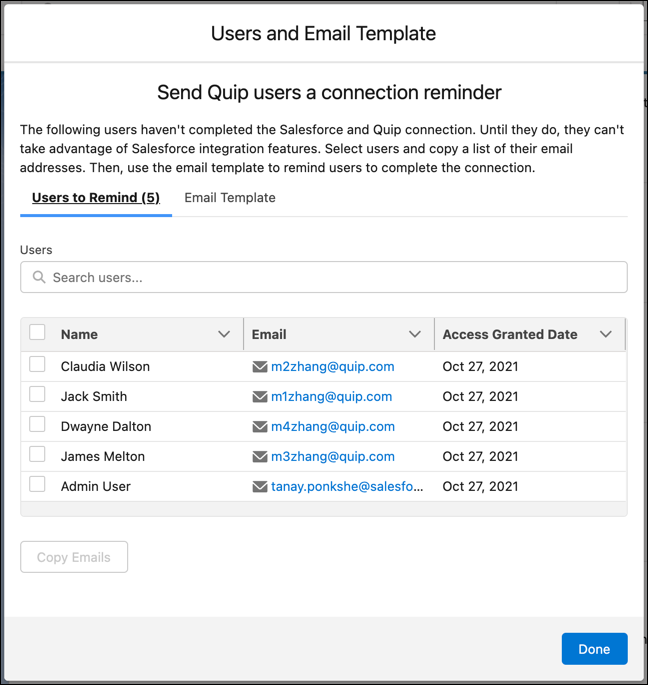
In the Users and Email Template window, the Users to Remind tab shows the Quip users who
haven’t connected to Salesforce. Select the users who you want to remind, and then click
Copy Emails.
Open your preferred email client and paste the copied email addresses in the To:
field.
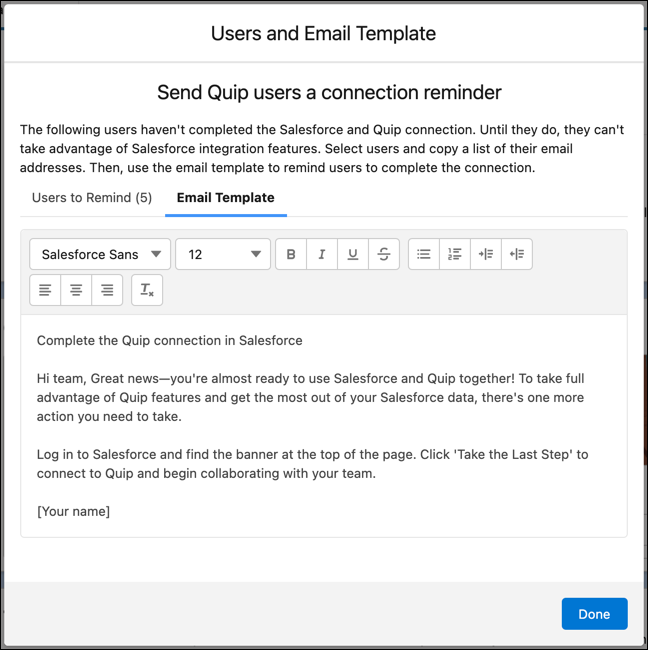
Return to the Users and Email Template window in Salesforce Setup, and then click the
Email Template tab.
To copy the email template, place your cursor in the text box and double-click. Then,
right-click or use a keyboard shortcut to copy.
Click Done.
In your email client, paste the copied text into the email body.
Select Complete the Quip connection in Salesforce and right-click or
use a keyboard shortcut to cut. Then, paste the text in the subject line.
Send the email.
Did this article solve your issue?
Let us know so we can improve!
Loading
Salesforce Help | Article
Cookie Consent Manager
General Information
Required Cookies
Functional Cookies
Advertising Cookies
General Information
We use three kinds of cookies on our websites: required, functional, and advertising. You can choose whether functional and advertising cookies apply. Click on the different cookie categories to find out more about each category and to change the default settings.
Privacy Statement
Required Cookies
Always Active
Required cookies are necessary for basic website functionality. Some examples include: session cookies needed to transmit the website, authentication cookies, and security cookies.
Functional Cookies
Functional cookies enhance functions, performance, and services on the website. Some examples include: cookies used to analyze site traffic, cookies used for market research, and cookies used to display advertising that is not directed to a particular individual.
Advertising Cookies
Advertising cookies track activity across websites in order to understand a viewer’s interests, and direct them specific marketing. Some examples include: cookies used for remarketing, or interest-based advertising.