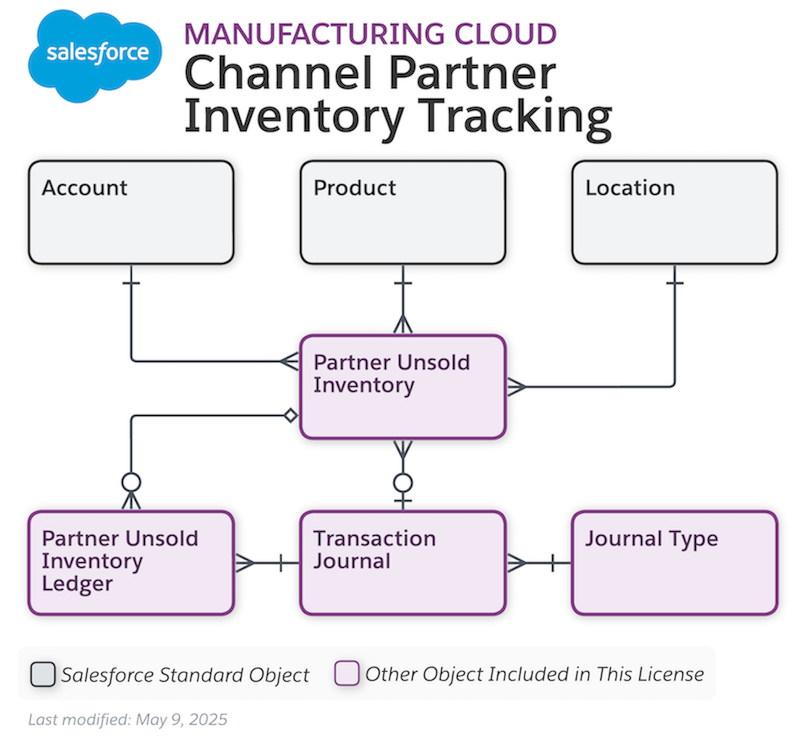
The Channel Partner Inventory Tracking Cloud data model includes objects and fields that
you can use to store information about your channel partner inventory tracking operations. The
data model is built with industry-wide best practices, and you can adapt and extend the data model
to meet your company’s unique needs.
Required Editions
Available in: Enterprise, Professional, and Unlimited Editions
with the Channel Revenue Management add on
Use these objects to store information about your entire channel partner inventory
tracking operations.
Channel Partner Inventory Tracking Objects
Object
Description
Transaction Journal
Stores information about transactions, such as points of sales and point of sale returns.
Partner Unsold Inventory
Stores the unsold quantity of inventory available with the partner.
Partner Unsold Inventory Ledger
Stores the remaining quantity of unsold inventory available with the partner and also calculates onhold quantities.
Rebate Program
Stores rebate programs your organization runs with a single account, all accounts, or specific list of accounts.
Program Rebate Type Product
Stores a junction between a program rebate type and a product.
Price Protection Term
Stores all price protection term records.
Rebate Program Member
Stores information about members of a rebate program, eligible for rebate payments.
Rebate Partner Special Pricing Term
Stores information about the special pricing term for a ship and debit program.
Did this article solve your issue?
Let us know so we can improve!
Loading
Salesforce Help | Article
Cookie Consent Manager
General Information
Required Cookies
Functional Cookies
Advertising Cookies
General Information
We use three kinds of cookies on our websites: required, functional, and advertising. You can choose whether functional and advertising cookies apply. Click on the different cookie categories to find out more about each category and to change the default settings.
Privacy Statement
Required Cookies
Always Active
Required cookies are necessary for basic website functionality. Some examples include: session cookies needed to transmit the website, authentication cookies, and security cookies.
Functional Cookies
Functional cookies enhance functions, performance, and services on the website. Some examples include: cookies used to analyze site traffic, cookies used for market research, and cookies used to display advertising that is not directed to a particular individual.
Advertising Cookies
Advertising cookies track activity across websites in order to understand a viewer’s interests, and direct them specific marketing. Some examples include: cookies used for remarketing, or interest-based advertising.