Keep your Salesforce CMS workspace tidy and your content organized with folders. Create
folders with up to five levels of hierarchy, and edit, move, rename, and delete folders to
easily navigate the content in your workspace. Folders are unique to each CMS workspace, and
they’re shared with every user in that workspace.
Required Editions
Available in: Lightning Experience
Available in: Enterprise, Performance, Unlimited, and
Developer Editions
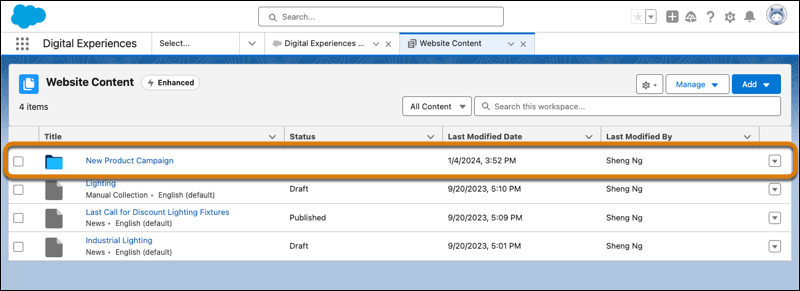
Add folders to a workspace, and then view the folders in the workspace content list.
Folders appear at the top of the content list, above individual content
items.
Each folder has a folder ID that appears in the URL. The folder ID is a unique,
alphanumeric identifier automatically assigned to the folder when it’s created. Because of
this unique ID, folders are unique to the workspace and can’t be moved to another workspace.
Bookmark the URL to readily find and share the link to specific folders with other members
of the workspace.
To organize your content into folders, first create a folder in a CMS workspace. Then
select your content, and move it into a folder. Or open a folder and create new content.
Then move the content between folders or back to the workspace.
Create Folders in a CMS Workspace Use folders to organize all content types in your workspace. Create a folder hierarchy with child folders up to five levels, and add content to any level.
We use three kinds of cookies on our websites: required, functional, and advertising. You can choose whether functional and advertising cookies apply. Click on the different cookie categories to find out more about each category and to change the default settings.
Privacy Statement
Required Cookies
Always Active
Required cookies are necessary for basic website functionality. Some examples include: session cookies needed to transmit the website, authentication cookies, and security cookies.
Functional Cookies
Functional cookies enhance functions, performance, and services on the website. Some examples include: cookies used to analyze site traffic, cookies used for market research, and cookies used to display advertising that is not directed to a particular individual.
Advertising Cookies
Advertising cookies track activity across websites in order to understand a viewer’s interests, and direct them specific marketing. Some examples include: cookies used for remarketing, or interest-based advertising.