Allow Data Analysis with Einstein Data Exploration Consent
Use Einstein Data Exploration Consent to manage project and object permissions for
Salesforce data scientists. With this access, Salesforce can develop and improve your Einstein
features. For example, you can see the content that your customers pay attention to and find
patterns to best advertise your products or services.
Required Editions
Available in: Lightning Experience in Professional, Enterprise,
Performance, Unlimited, and Developer Editions.
User Permissions Needed
To grant access to apps and objects in Einstein Data Exploration Consent:
Data Exploration
To grant project and object permissions in Salesforce requires a pilot program agreement with
Salesforce. To participate in a pilot program, contact your Salesforce Account Executive.
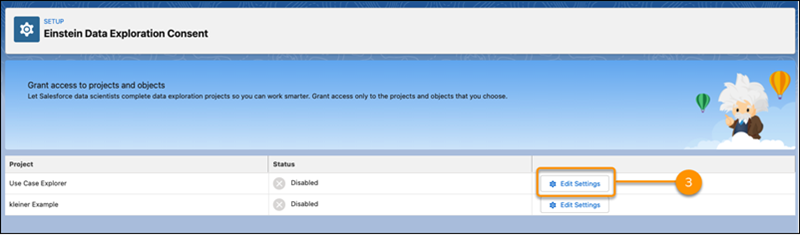
To grant access to projects and objects:
From Setup, in the Quick Find box, enter Einstein Data Exploration
Consent, and then select Einstein Data Exploration
Consent.
Find the project that you want Salesforce data scientists to access. In this example, the
project is Use Case Explorer.
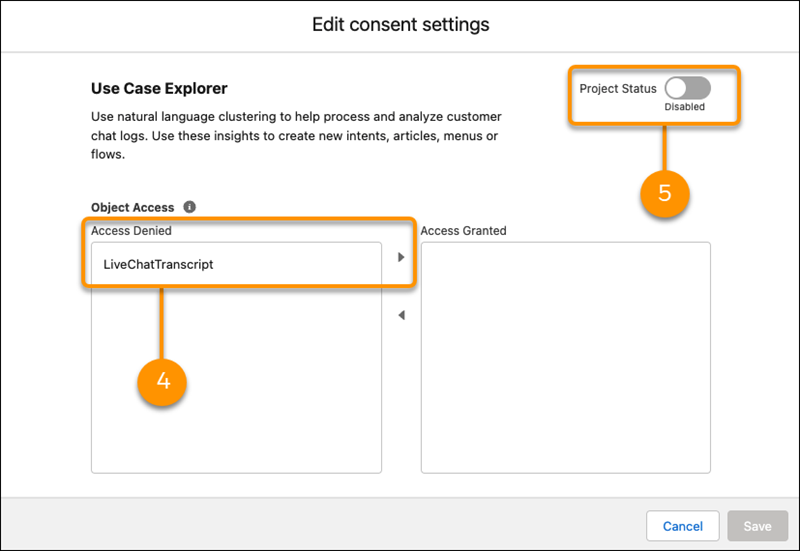
Select Edit Settings.
Under Access Denied, select the objects that you want to grant access to and use the arrow
to move them to the Access Granted column.
Enable Project Status.
Save your changes.
Tell your Salesforce pilot program contact that you granted project and object permissions.
Did this article solve your issue?
Let us know so we can improve!
Loading
Salesforce Help | Article
Cookie Consent Manager
Cookie Consent Manager
General Information
Required Cookies
Functional Cookies
Advertising Cookies
General Information
We use three kinds of cookies on our websites: required, functional, and advertising. You can choose whether functional and advertising cookies apply. Click on the different cookie categories to find out more about each category and to change the default settings.
Privacy Statement
Required Cookies
Always Active
Required cookies are necessary for basic website functionality. Some examples include: session cookies needed to transmit the website, authentication cookies, and security cookies.
Functional Cookies
Functional cookies enhance functions, performance, and services on the website. Some examples include: cookies used to analyze site traffic, cookies used for market research, and cookies used to display advertising that is not directed to a particular individual.
Advertising Cookies
Advertising cookies track activity across websites in order to understand a viewer’s interests, and direct them specific marketing. Some examples include: cookies used for remarketing, or interest-based advertising.