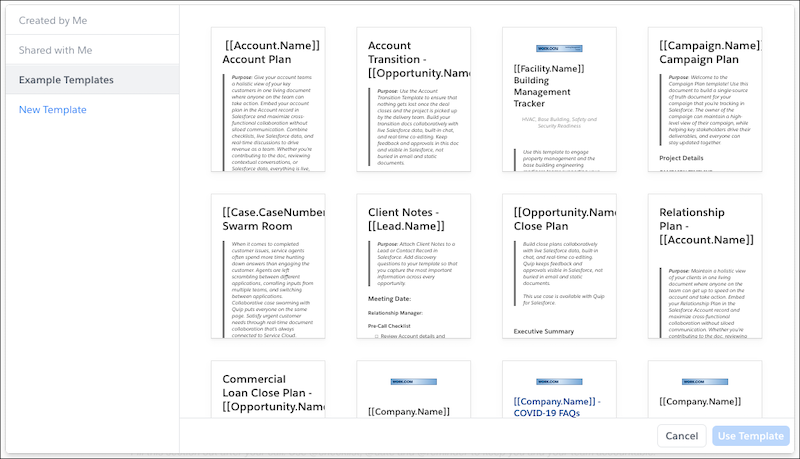
Make it easy to find and create templates in Quip. With the Template Library, users can
create and share templates in private galleries, like the Created by Me and Shared with Me
galleries, or get started with example templates.
Required Editions
Available in: Lightning Experience
Easily find your templates in the Created by Me private gallery, make changes, and create a
document from a template. To collaborate on a template shared with you, go to your Shared with Me
private gallery. You and your team can edit an unlocked template and tailor it to your business
needs before you share it with others. Get up and running with some popular example templates,
like Account Plans and Mutual Close Plans. They’re prefilled with mail merge syntax to save time
and give you a head start in template creation.
Template Library for Administrators Quip site admins can create custom galleries, called company galleries, to organize templates thematically and publish them for their Quip site users.
Did this article solve your issue?
Let us know so we can improve!
Loading
Salesforce Help | Article
Cookie Consent Manager
General Information
Required Cookies
Functional Cookies
Advertising Cookies
General Information
We use three kinds of cookies on our websites: required, functional, and advertising. You can choose whether functional and advertising cookies apply. Click on the different cookie categories to find out more about each category and to change the default settings.
Privacy Statement
Required Cookies
Always Active
Required cookies are necessary for basic website functionality. Some examples include: session cookies needed to transmit the website, authentication cookies, and security cookies.
Functional Cookies
Functional cookies enhance functions, performance, and services on the website. Some examples include: cookies used to analyze site traffic, cookies used for market research, and cookies used to display advertising that is not directed to a particular individual.
Advertising Cookies
Advertising cookies track activity across websites in order to understand a viewer’s interests, and direct them specific marketing. Some examples include: cookies used for remarketing, or interest-based advertising.