
You are here:
Rebate Management Data Model
Learn about the objects in the Rebate Management data model.
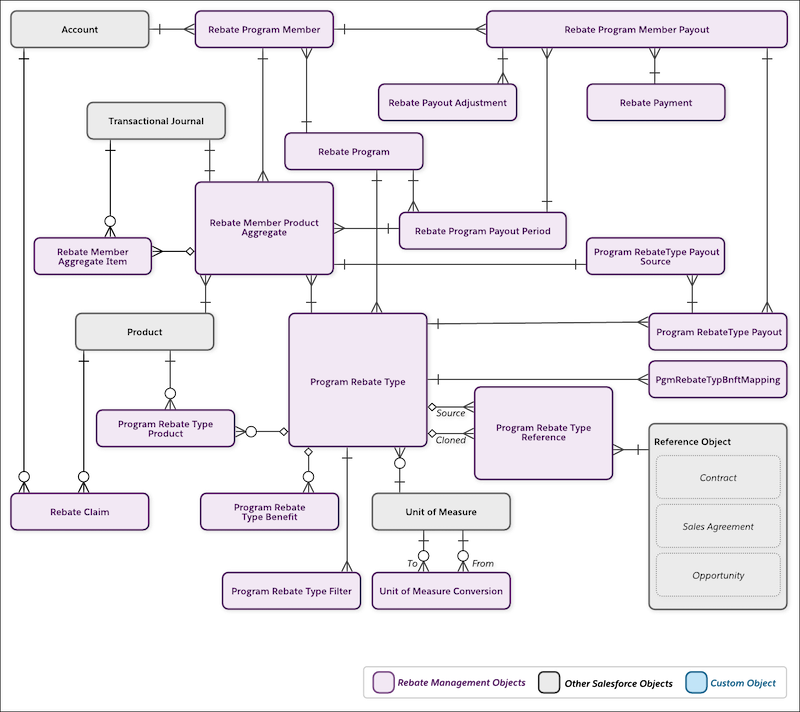
Define an Incentive Structure
Use these objects to design the framework:
- Rebate Program: Name, description, payout frequency, and validity of a rebate program. It’s a top-level object that shares a primary-detail relationship with the Rebate Program Payout Period, Rebate Program Member, and Rebate Program Type objects.
- Rebate Program Payout Period: Information about dates and periods that payouts are calculated for. The duration of a payout period depends on the payout frequency and validity of a program. For a monthly program valid for a year, this object holds 12 payout period records. For a custom frequency, the number of records is user-defined.
- Rebate Program Member: Information about the accounts that are enrolled in a rebate program as members. The transactions of active member records are eligible for payout calculations. Account is a lookup object in Rebate Program Member.
- Program Rebate Type: Information about the type of incentives offered through a rebate program. A rebate type record includes information about which payout type is offered, how transactions are aggregated, and how payouts are calculated.
Add Granularity to Incentives
Use these objects to define the granular details and rules:
- Program Rebate Type Benefit: Rebate attainment threshold information for a member. Decide maximum and minimum values for a range, and then define the benefit value for each range.
- Program Rebate Type Benefit Mapping: Field mappings between the Rebate Member Product Aggregate and Program Rebate Type Benefit objects. If the benefits vary by criteria, such as Product, Category, or Region, these fields map between benefit and aggregate objects.
- Program Rebate Type Filter: Rules that determine eligible member transactions for rebate payouts. The object is also used in predefined data processing engine definitions that process the transaction journal records.
- Program Rebate Type Product: Association of product records with a program rebate type record. Based on the products excluded from or included in a rebate type, only transaction records for eligible products are considered for payout processing.
- Program Rebate Type Reference: Association of eligible rebate types with a target record for standard or custom objects. The Program Rebate Type Reference is a junction object that connects an integrable Program Rebate Type record with another object’s record. Examples of target objects: Contract, Opportunity, Quote, Order, and Sales Agreement.
- Unit of Measure Conversion: Information on the unit of measure used in transactions, the unit of measure to use for payouts, and the conversion factor. The Unit of Measure Conversion is a junction object between Unit of Measure and Program Rebate Type.
Manage Transactions and Calculations
Use these objects to manage transactions, aggregation logic, and other processes that help you to calculate payouts:
- Transaction Journal: Transaction records of rebate program members that are used for processing payouts at the end of each period. You can add transaction records to the Transaction Journal from external systems, from existing objects, or from claims submitted by partners.
- Received Document: CSV files that contain claims submitted by partners through the Experience Cloud site. These claims are validated and then converted into Transaction Journal records for payout processing.
- Rebate Member Product Aggregate: Filtered and aggregated transaction records for members in each payout period. Transaction Journal records are processed by a data processing engine and the results are written back to the object. Admins can create a custom object to store aggregate records if necessary. The values in the object update with each run of the data processing engine. On the payout calculation date, the latest aggregate values are used to calculate the member payouts for that period.
Track Payouts
Use these objects to track payments made to members for a rebate program:
- Rebate Program Member Payout: Rebate amount calculated for a member for a specific period for all rebate types.
- Program Rebate Type Payout: Rebate amount calculated for a member for a specific period, with separate rows for each rebate type. The values of all rows show as a single row in the Rebate Program Member Payout object.
- Program Rebate Type Payout Source: Rebate amount calculated for each row in the Rebate Member Product Aggregate object. The values of all rows show as a single row in the Program Rebate Type Payout object.
- Rebate Payout Adjustment: Manual adjustments made to member payout records before the amounts are approved or rejected through an approval process.
- Rebate Payment: Final payout amount for a member for each payout period. The object helps you to manage and track the amounts that are due for payment or already paid to each member.
See Also
Did this article solve your issue?
Let us know so we can improve!
