
Create a Custom Report Type in the Enhanced Custom Report Type Builder
A custom report type provides more flexibility with object relationships. It can include fields from objects with lookup relationships to expand the data available for report users. You can build a custom report type in the Enhanced Custom Report Type Builder on any object, even objects that you don’t have permission to view.
Required Editions
| Available in: Lightning Experience |
| Available in: Essentials, Professional, Enterprise, Performance, Unlimited, and Developer Editions |
| User Permissions Needed | |
|---|---|
| To create and update custom report types: | Manage Custom Report Types |
Watch this video on creating a custom report type using the enhanced report type builder.
View this video in a separate tab.
These steps apply to the enhanced custom report type experience. If the Report Types page in Setup resembles the one shown here and the Enhanced Custom Report Type Setup Page preference in Reports and Dashboards Settings is selected, continue with these steps. Otherwise, use Create a Custom Report Type in the Legacy Custom Report Type Builder
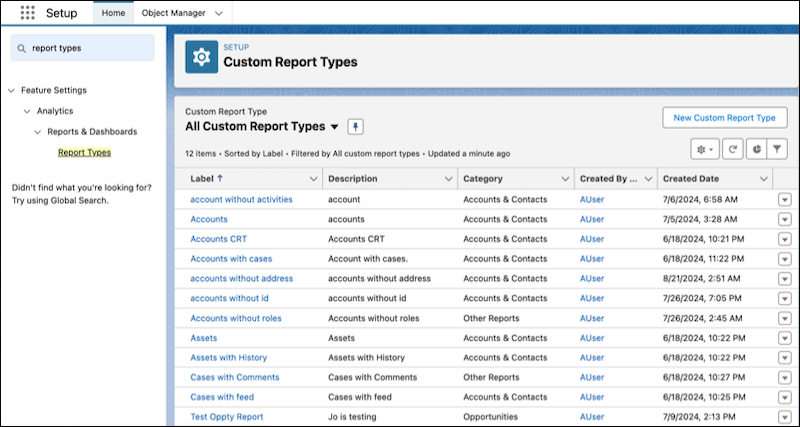
- In Setup, in the Quick Find box, enter and select Report Types.
- On the Custom Report Types welcome page, click Continue.
- Click New Custom Report Type.
- Enter the report type details.
- Select the primary object for your custom report type.After you save the report type, you can’t change the primary object.
- Enter a unique display label, an API name, and a description to inform users which data is available in the report.
- Select the category for the custom report type to help users find it.
- Select an availability status.
- During design and testing, select In Development. The report type and its reports are hidden from all users except those with the Manage Custom Report Types permission. Only users with that permission can create and run reports when a report type is in development.
- If you’re ready to let all users access the report type, select Deployed.
- Select the primary object for your custom report type.
- Click Next.
- (Optional) If you want to include fields from more than just the primary object, add
related objects. You can also specify which records from the child objects are included in the
report results.
- Click Click to relate another object.
- Select the criteria for the relationship.
- If you select Each "A" record must have at least one related "B" record, only parent records with child records are included in the report. If you’re using Essentials Edition, you can only choose this option.
- If you select "A" records may or may not have related "B" records, parent records are shown whether or not they have child records. All subsequent relationships use the may-or-may-not association.
- Add more objects as needed, and then click Save.
- (Optional) To control which fields are available in a report, click Edit
LayoutAll custom reports based on that object include the fields that you specify.
- From the Fields panel, drag the fields that you want to include to the required section. You can also change their display names.
- Create a section and add fields to display under that section. You can save the new section only if it contains at least one field.
- Hide a section to exclude it from the report. Click Sections and deselect the checkbox next to the section name.
- If you add a field or section by mistake, click the undo icon
 to revert the action. Click the redo icon
  to restore the change you reverted.
 - To add fields from objects that aren't included in the report type’s structure, click Lookup Fields.
After creating the custom report type, deploy it to make it available to other users. In
the Custom Report Types page in Setup, click  next to
the report type, and select Start Report to load the report containing
fields and sections of your report type. To view details of the report type, click and select Details.
next to
the report type, and select Start Report to load the report containing
fields and sections of your report type. To view details of the report type, click and select Details.
