
You are here:
Aggregate Node: Roll Up Data to a Higher Level
Use an Aggregate node to roll up data to a higher granularity in Salesforce Data Pipelines. You can aggregate using: unique, sum, average, count, maximum, and minimum. You can group by any dimension or date column. You can also pivot dimensions as columns. For example, you can group opportunities by account to get account-level details, like total opportunity amount, average number of cases, and the average days to close an opportunity for each account. You can then pivot on account type to analyze each combination of account and account type.
| User Permissions Needed | |
|---|---|
| To manage and create a recipe: | Edit CRM Analytics Dataflows OR Edit Dataset Recipes |
- In a Data Prep recipe that already has at least one Input node, select the Add Node
button (
 ) between two nodes or at the end of the recipe. To show the Add Node button
between two nodes, hover the cursor on the connecting line.
) between two nodes or at the end of the recipe. To show the Add Node button
between two nodes, hover the cursor on the connecting line. - In the Add Node dialog box, select Aggregate.

- Add at least one aggregate.
Before you can add a grouping, add an aggregate. You can select one of the following aggregate functions.
Aggregate Function Description Unique Counts only unique values in the selected column. Sum Calculates the total by adding all values in the selected column. Average Calculates the average value of the selected column. Count Counts all values in the selected column. Maximum Calculates the maximum value of the selected column. Minimum Calculates the minimum value of the selected column. Stddevp Calculates the population standard deviation. Population standard deviation measures the spread of data distribution—the typical distance between each data point and the average. Stddev Calculates the sample standard deviation. Sample standard deviation measures the spread of data distribution for a given sample. Use sample standard deviation to estimate the population standard deviation based on a sample. Varp Calculates the population variance. Population variance indicates how spread out data points are in a specific population. Var Calculates the sample variance. Sample variance indicates how spread out data points are for a given sample. Use sample variance to estimate the population variance based on a sample. 
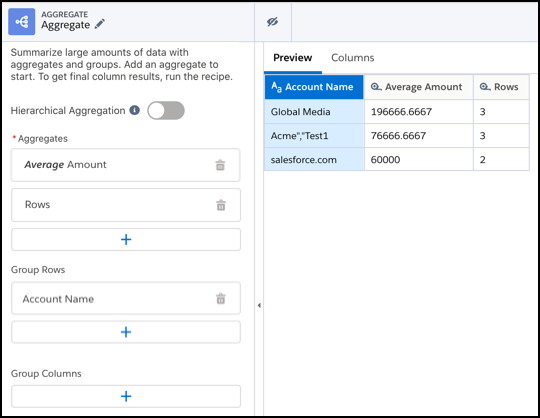
- To group rows, add one or more dimension or date columns in the Group Rows
field.
For example, you can group by account name.
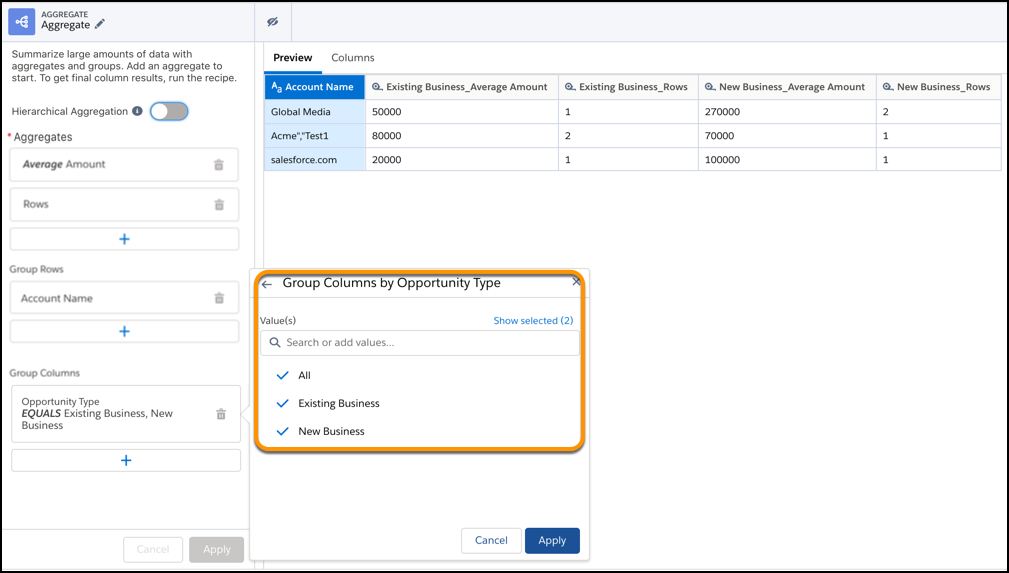
- To pivot dimensions as columns, add up to two dimension columns in the Group Columns
field, select the values for each dimension column, and click
Apply. For direct datasets and datasets, you can search for all
column values. Otherwise, you are limited to preview data. If a value doesn’t appear in
the list, adjust your sample size or refine your search. Then, click Add new
value and enter the value.
For example, you can group columns by opportunity type. Each combination of opportunity type and aggregate appears as a separate column.
- To add the Aggregate node to the recipe, click Apply.
- Save the recipe.

Your values that aren’t picked are automatically included in an Other column when you pivot with the Data Prep aggregate node. For example, you can group columns by opportunity type, select your most important types, and let the rest be grouped as Other.
