In Salesforce Data Pipelines, you can split the strings in a text column into two
values by specifying a delimiter. To split column values into more than two parts, add multiple
instances of the Split transformation. For instance, you can use 3 Split transformations in a
Data Prep recipe to split the full address into the following components: street address, city,
state, and zip code.
Required Editions
Split Transformation: Break Up Column Values
User Permissions
Needed
To create a recipe:
Edit CRM Analytics Dataflows OR Edit Dataset Recipes
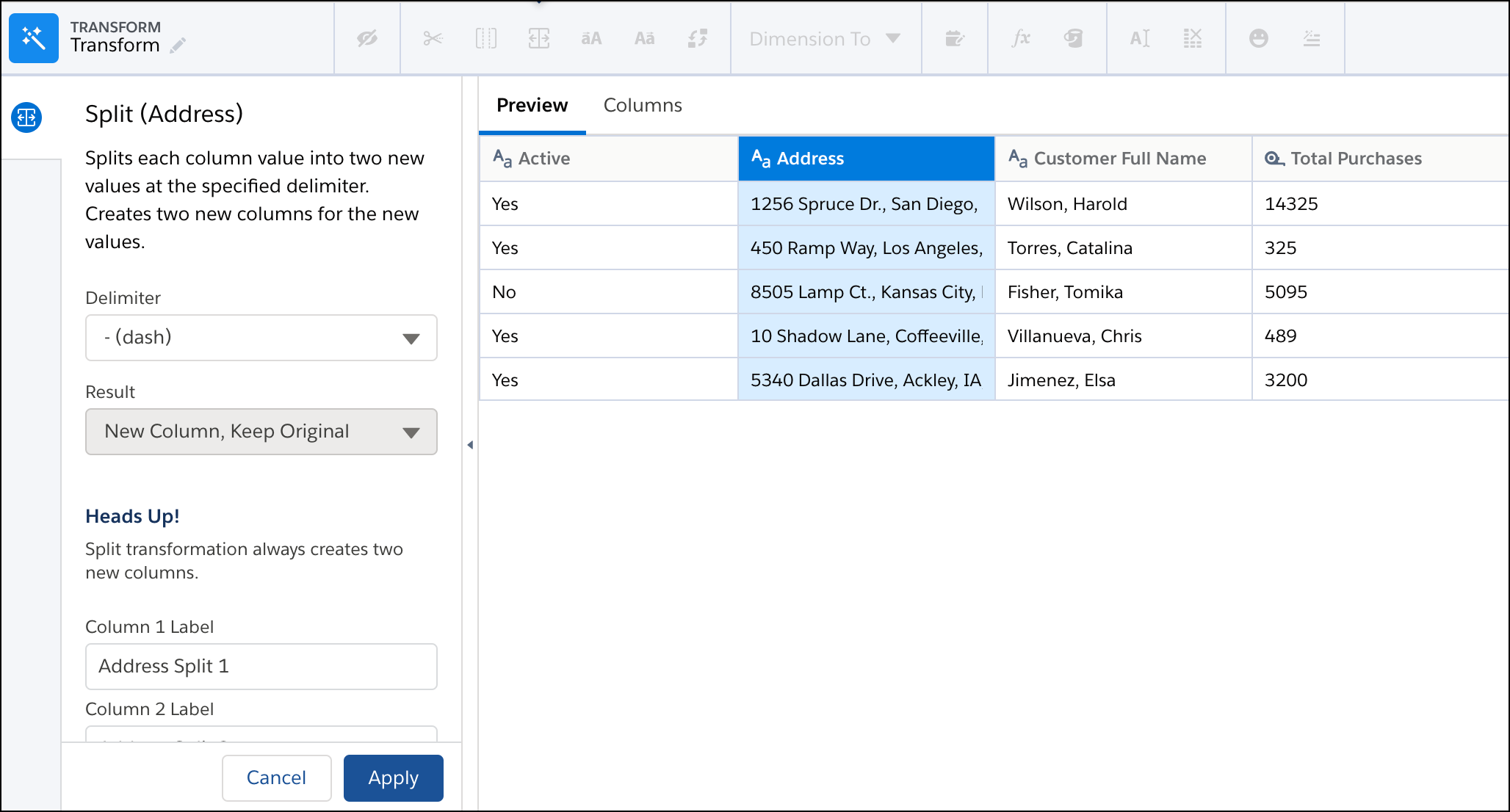
In a Transform node of a Data Prep recipe, select the text (dimension) column in the
Preview tab.
In the Transform toolbar, click the Split button ().
Select the delimiter in the Delimiter field.
For example, if address components are
separated by a comma in the Address field, specify comma as the delimiter.
Specify the column labels for both new columns.
Click Apply to add the transformation to the Transform
node.
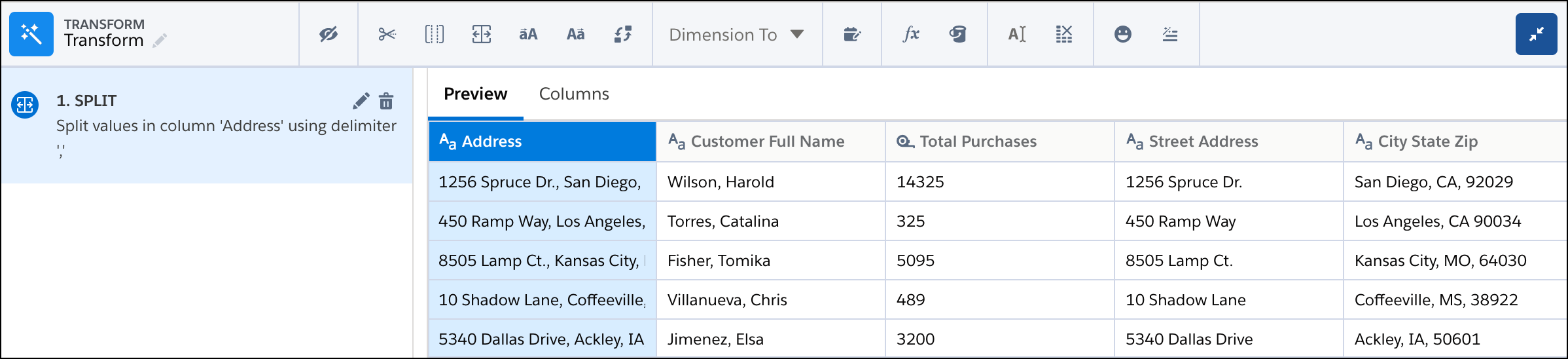
Going back to the address example, the Address field is split into two. The
Split transformation splits the value at the first occurrence of the delimiter. In this
case, the first comma appears after the street address. So the full address is broken
into the street address and the rest (city, state, and ZIP code).
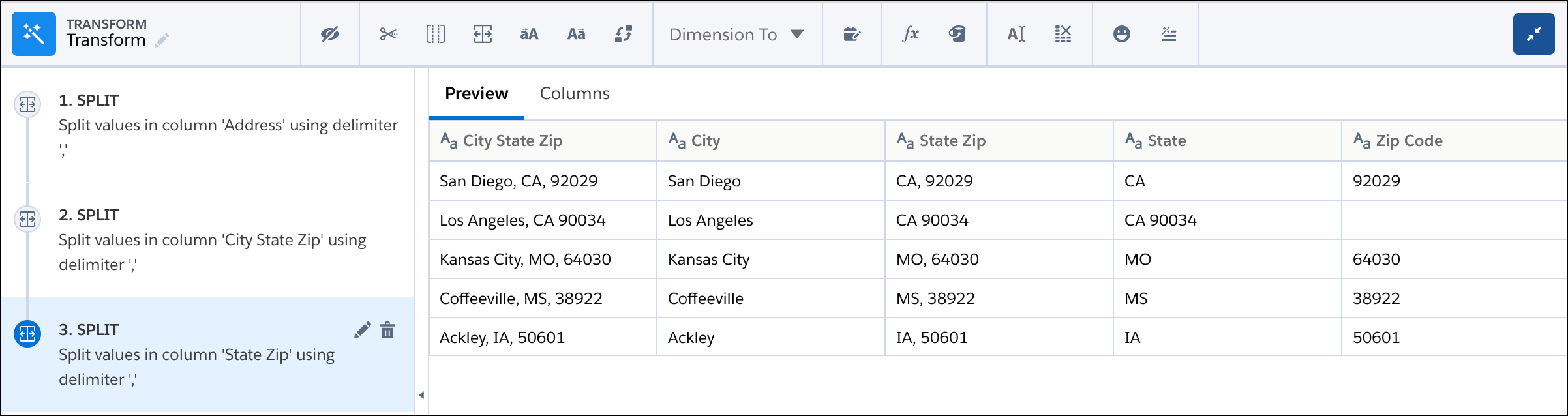
If needed, add the Split transformation again to further split the column
values.
For example, to finish splitting the city, state, and ZIP code, we can add two
more Split transformations.
To view the Graph area, click the Collapse button ().
Save the recipe.
If you don’t need the original column you split, add the Drop Columns transformation
after the Split transformation to drop it from the recipe. From that point, the original
column doesn’t appear in Preview anymore.
Did this article solve your issue?
Let us know so we can improve!
Loading
Salesforce Help | Article
Cookie Consent Manager
General Information
Required Cookies
Functional Cookies
Advertising Cookies
General Information
We use three kinds of cookies on our websites: required, functional, and advertising. You can choose whether functional and advertising cookies apply. Click on the different cookie categories to find out more about each category and to change the default settings.
Privacy Statement
Required Cookies
Always Active
Required cookies are necessary for basic website functionality. Some examples include: session cookies needed to transmit the website, authentication cookies, and security cookies.
Functional Cookies
Functional cookies enhance functions, performance, and services on the website. Some examples include: cookies used to analyze site traffic, cookies used for market research, and cookies used to display advertising that is not directed to a particular individual.
Advertising Cookies
Advertising cookies track activity across websites in order to understand a viewer’s interests, and direct them specific marketing. Some examples include: cookies used for remarketing, or interest-based advertising.