Share survey invitations with a wider audience on WhatsApp and Facebook Messenger, and
allow participants to respond on the go by sharing invitation links in an SMS. This feature is
available only in standard Messaging channels.
Required Editions
Available in: both Salesforce Classic and
Lightning Experience
Available in: Enterprise, Unlimited, and Developer
Editions
Available with the Feedback Management - Starter and Feedback Management - Growth
licenses
User Permissions Needed
To configure a survey invitation for a messaging channel:
Customize Application
From Setup, in the Quick Find box, enter Messaging, and then select
Messaging Settings.
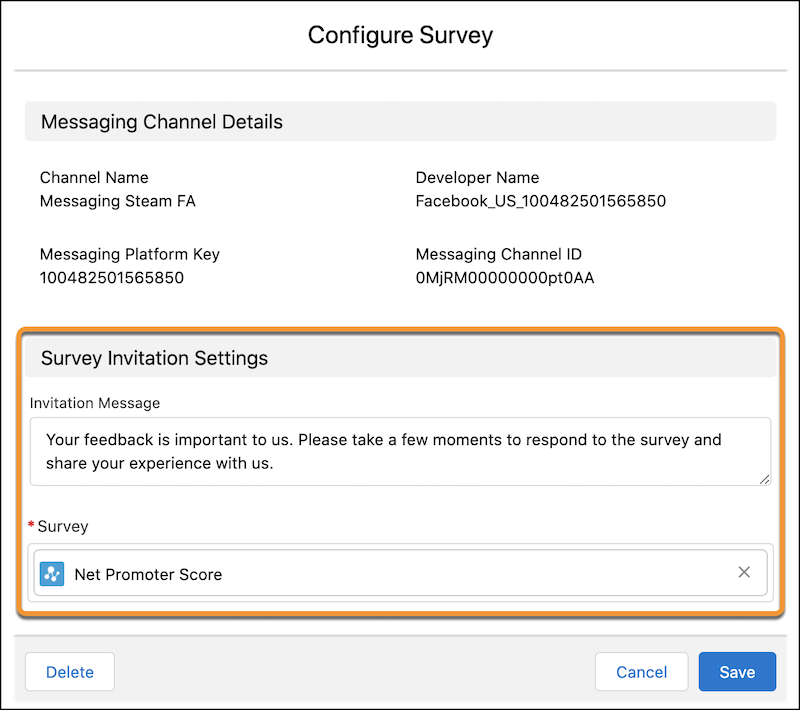
Click the action menu for a standard messaging channel and select Configure
Survey.
In the Survey Invitation Settings section, add a message to send with the invitation and
select the survey to send.
Note Salesforce Feedback Management doesn't support translating the invitation message.
Save your changes.
At the conclusion of a standard messaging session, Salesforce Feedback Management sends
the survey invitation as a separate message. The invitation sent is based on the type of user
associated with the messaging session, such as end user contact, case contact, or lead ID. The
survey participant is derived from the context of the chat session. A survey subject record is
associated with the survey invitation when the messaging session uses any of these objects:
Case
Lead
End User Account
Opportunity
End User Contact
Case Contact
Messaging Session
Did this article solve your issue?
Let us know so we can improve!
Loading
Salesforce Help | Article
Cookie Consent Manager
General Information
Required Cookies
Functional Cookies
Advertising Cookies
General Information
We use three kinds of cookies on our websites: required, functional, and advertising. You can choose whether functional and advertising cookies apply. Click on the different cookie categories to find out more about each category and to change the default settings.
Privacy Statement
Required Cookies
Always Active
Required cookies are necessary for basic website functionality. Some examples include: session cookies needed to transmit the website, authentication cookies, and security cookies.
Functional Cookies
Functional cookies enhance functions, performance, and services on the website. Some examples include: cookies used to analyze site traffic, cookies used for market research, and cookies used to display advertising that is not directed to a particular individual.
Advertising Cookies
Advertising cookies track activity across websites in order to understand a viewer’s interests, and direct them specific marketing. Some examples include: cookies used for remarketing, or interest-based advertising.