
You are here:
Salesforce Configuration Management Database and Service Graph
Easily manage your IT landscape by using Salesforce Configuration Management Database (CMDB) and Service Graph to track and understand all your configuration items. CMDB helps IT admins maintain accurate records of assets, ownership, and dependencies. Ensure smoother operations and more reliable IT services by structuring your asset data logically.
Required Editions
| Available in: Lightning Experience |
| Available in: Unlimited, Enterprise, and Performance Editions with Agentforce IT Service that have CMDB and Service Graph enabled. |
CMDB is a centralized repository that stores structured data about the assets in your IT environment. The assets, known as configuration items (CIs), include physical devices, virtual machines, software applications, cloud services, and other components that support IT operations. Each CI is categorized by type and includes attributes that describe its key properties.
- Learn and Explore CMDB
Learn how Configuration Management Database (CMDB) helps you track, manage, and make sense of your organization’s assets. Explore core benefits, understand key terms, and see how configuration items evolve over time. - Plan and Prepare for your CMDB Implementation
Learn how to set up your Configuration Management Database (CMDB), assign the right permissions, and configure foundational settings to start using CMDB. - Configuration Items in CMDB
Configuration items (CIs) represent the individual assets in your IT environment. Each CI stores key details about a specific hardware or software component, helping your teams track, manage, and understand the infrastructure that supports your business. CIs provide the foundation for service management, impact analysis, and discovery. - Configuration Item Types in CMDB
A configuration item (CI) type specifies which attributes, relationships, and rules apply to the CIs that belong to it. Defining CI types helps your team maintain consistency and simplify data management across different asset categories. - Configuration Item Attributes and Attribute Sets in CMDB
Configuration item (CI) attributes define which details are tracked for each asset in your CMDB, such as the technical properties, ownership, and location. You can group related attributes into attribute sets to maintain consistency across similar CI types and streamline data entry. - Configuration Item Relationships and Service Graphs in CMDB
A configuration item (CI) relationship defines how assets in your Configuration Management Database (CMDB) interact with each other. The service graph visualizes the relationships to show how systems are connected and where dependencies exist. Together, they help you monitor infrastructure health, analyze impact, and troubleshoot issues faster by understanding how assets work together across your IT landscape. - Identification Rules in CMDB
Maintain clean and reliable asset records in Configuration Management Database (CMDB) by using identification rules. Determine how the system identifies configuration items (CIs) when new data is added, either manually or through discovery. By matching key attributes like serial number or MAC address, identification rules prevent duplicates, reduce confusion, and ensure the right CI record gets updated. - Integration of CMDB with IT Service Records Using Affected and Impacted CIs
Track how Configuration Items (CIs) relate to IT service records like incidents, problems, and change requests. Use affected and impacted CI references to improve context, speed up resolution, and reduce service disruption. - Get Insights into Your Configuration Data with CMDB Dashboard
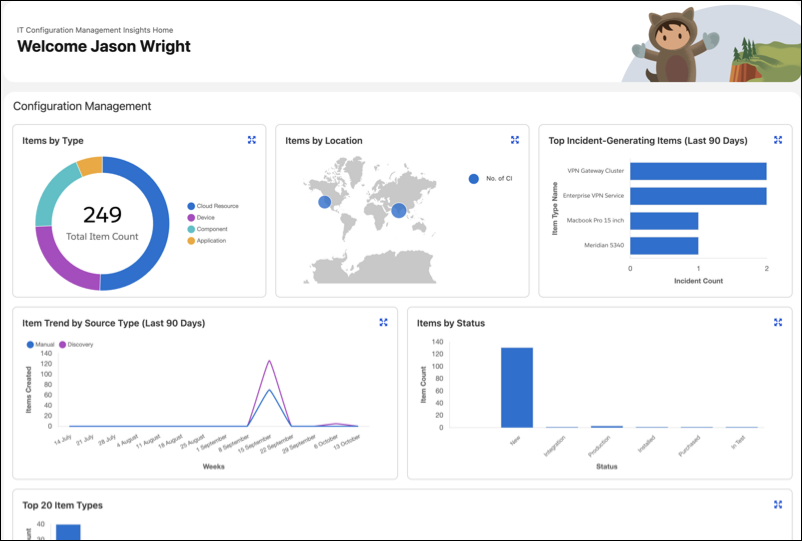
Use the Configuration Management Database (CMDB) dashboard to monitor configuration trends and asset health across your organization. Gain visibility into configuration accuracy, recent activity, and data quality to make informed decisions and reduce operational risks. - CMDB Enterprise
The CMDB Enterprise license enables organizations to manage enterprise Configuration Items (CIs) and applies usage-based metering for qualifying configuration items.
